
RBT exam flashcards can make review faster, but flipping through terms is only the first step. A useful card should help you recognize an observable fact, distinguish a nearby concept, choose a role-safe next action, and explain why the other choices do not fit. That is how a small deck becomes a bridge from recall to application.
Table of Contents
- What RBT exam flashcards should test
- Map RBT exam flashcards to six domains
- Write a high-quality RBT exam flashcard
- Use RBT exam flashcards for contrasts
- Study RBT exam flashcards with retrieval
- Correct RBT exam flashcard errors
- Build a six-domain flashcard deck
- Avoid these flashcard mistakes
- Frequently Asked Questions
- References
This guide explains how to build and use independent RBT exam flashcards around the current BACB RBT Test Content Outline, 3rd edition. The BACB Handbook and the current outline control credentialing, application, and examination information. Flashcards organize study; they do not replace the Handbook, an initial competency assessment, supervision, or the written plan for client services.
RBT Training is not affiliated with, operated by, or endorsed by the Behavior Analyst Certification Board (BACB). The examples below are newly written for independent study. They are not official, recalled, leaked, or BACB-endorsed questions, and no deck, practice score, or study schedule can guarantee a passing result or certification.
What RBT exam flashcards should test
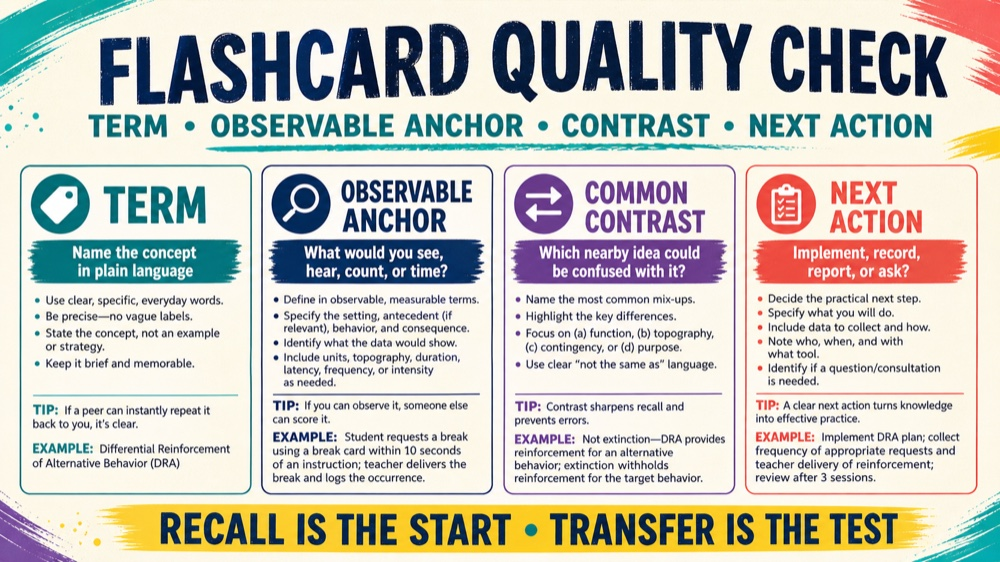
The best RBT exam flashcards do more than put a definition on the front and a definition on the back. Every card should make one small decision visible. Use this four-part test:
- Recognize: What fact can you observe, count, time, or verify?
- Contrast: Which nearby term or response could be confused with it?
- Act: What action is within the RBT role and the written plan?
- Explain: What makes the answer fit, and what would change it?
A card that asks only “What is frequency?” may support first exposure. A stronger card asks, “A response occurs 12 times during a session. Which measurement records the count?” Its back can name frequency, explain the observable unit, and contrast it with duration. The goal is not to make every card long. The goal is to make every answer usable.
| Card layer | Prompt | Why it matters |
|---|---|---|
| Term | What concept is being tested? | Supports retrieval. |
| Observable anchor | What would you see, hear, count, or time? | Separates data from interpretation. |
| Contrast | What is the closest competing concept? | Targets common confusion. |
| Next action | Implement, record, report, or ask? | Keeps the response role-safe. |
| Transfer | What if one fact changes? | Tests application rather than recognition. |
Keep the deck independent and accurately labeled. A set can be free, printable, interactive, or reviewed by a professional without becoming an official BACB product. Look for the author, edition, update date, source links, and a clear statement that the examples are original.
Map RBT exam flashcards to six domains
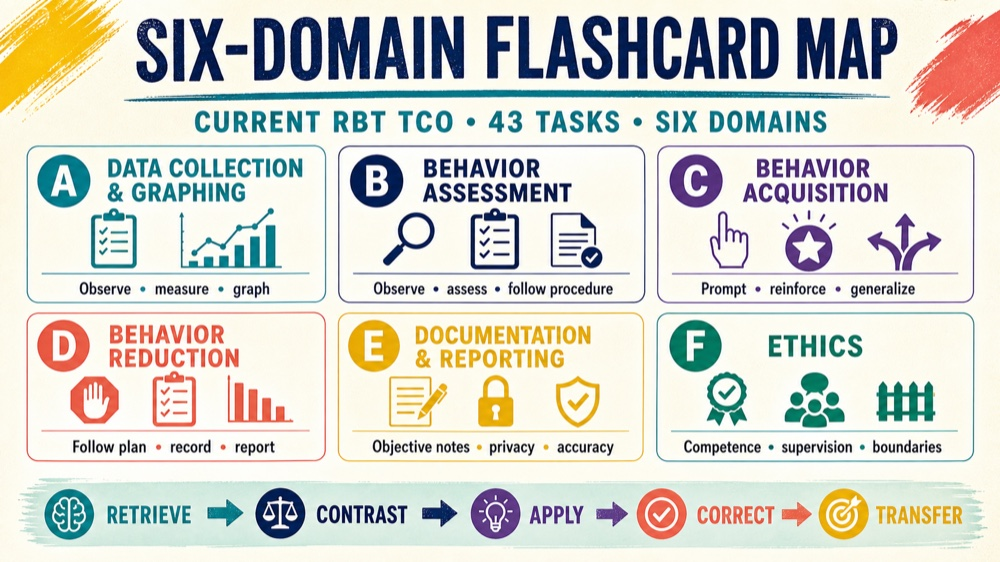
The current RBT Test Content Outline, 3rd edition, organizes 43 tasks across six domains. Use that map to audit coverage instead of counting cards alone:
| Domain | Tasks / outline share | Flashcard emphasis |
|---|---|---|
| A. Data Collection and Graphing | 13 / 17% | Observable definitions, measurement matching, data sheets, and graph reading. |
| B. Behavior Assessment | 8 / 11% | Assigned assessment steps, direct observation, preference, and skill assessment. |
| C. Behavior Acquisition | 19 / 25% | Teaching procedures, prompts, reinforcement, maintenance, and generalization. |
| D. Behavior Reduction | 14 / 19% | Plan fidelity, safety direction, objective recording, and supervisor reporting. |
| E. Documentation and Reporting | 10 / 13% | Objective notes, communication, data accuracy, and privacy. |
| F. Ethics | 11 / 15% | Competence, supervision, dignity, confidentiality, and professional boundaries. |
The outline percentages help you distribute practice; they do not create a separate domain score on the certification examination. Also keep the official format facts separate from your deck. The current Handbook describes 75 scored questions and 10 unscored pilot questions, four answer choices, and a 90-minute time limit. Those numbers describe the secure examination format, not the number of cards in an independent study set.
For example, a 60-card deck can include all six domains, but it should not imply that 60 cards predict the secure exam. Add a domain label and a source note to each card so you can find an under-studied area without inventing an official weighting rule.
Write a high-quality RBT exam flashcard
Use a repeatable template so every card earns its place:
- Front: one short scenario or question, not a paragraph of hints.
- Answer: name the concept or best action in plain language.
- Observable reason: identify the fact that supports the answer.
- Nearest contrast: say why one tempting alternative is different.
- Role boundary: state when the RBT follows the plan, records, reports, or asks the supervisor.
- Source label: identify a current primary source or mark the item as an original study explanation.
Use short cards for retrieval and longer notes outside the deck. A front that contains the definition, the answer, and three clues can feel easy without proving that you know the concept. Hide the reason until after you commit to an answer.
For example, write: “A learner begins a response 8 seconds after an instruction. Which measure captures the delay from instruction to response?” The answer is latency because the prompt defines an interval before the response begins. A duration card would instead ask how long the response continues after onset. The two cards should be studied together because the contrast is the learning target.
Use RBT exam flashcards for contrasts
Many missed items are not caused by forgetting a word. They happen because two plausible ideas are close together. Build paired RBT exam flashcards around these decision points:
- Frequency vs. duration: count how often a response occurs versus how long it continues.
- Latency vs. duration: measure the delay before onset versus the time after onset.
- Observable description vs. interpretation: record what happened instead of guessing a private state.
- Prompt vs. reinforcement: arrange help that evokes a response versus a consequence that changes future responding.
- Maintenance vs. generalization: check performance over time versus across people, settings, materials, or cues.
- Implementation vs. plan change: follow an assigned procedure versus asking the responsible professional about an alteration.
For each pair, create one “same surface, different decision” card. Change only one fact in the second card. Then write the exact clue that changed your answer. This is more diagnostic than marking a card simply “wrong.”
Ethics and documentation cards need the same structure. A scenario involving a client detail may look like a writing question, but the decision may be confidentiality. A note describing someone as “uncooperative” may look like ordinary language, but the safer correction is to replace the label with observable events and follow the approved documentation route.
Study RBT exam flashcards with retrieval
Use a short retrieval loop instead of rereading the entire deck:
- Read the front and answer aloud before flipping the card.
- Give a reason tied to an observable fact, not just a word match.
- Mark the card as secure, uncertain, or incorrect.
- For an uncertain or incorrect card, write the nearest contrast.
- Review the difficult card again after a short delay.
- Finish with one new scenario where a fact has changed.
In a 20-minute session, use a small mixed set: a few data cards, one assessment card, one acquisition card, one reduction card, one documentation card, and one ethics card. In a longer session, sort errors by decision type rather than by emotion. “I guessed” is a starting point; “I treated an interpretation as an observable measure” tells you what to repair.
Do not use a flashcard score as a prediction of a certification result. A card score tells you what to review next. It does not establish eligibility, replace an assessment, or reproduce secure examination content.
Correct RBT exam flashcard errors
A correction log turns RBT exam flashcards into a feedback system. Save five fields:
| Field | Write this |
|---|---|
| Card ID | Domain and concept, such as A-latency. |
| Your answer | The exact response you gave, without rewriting it. |
| Decision error | Wrong unit, unsupported inference, plan change, or privacy issue. |
| Correct rule | One sentence tied to the observable clue. |
| Transfer card | A new scenario with one changed fact. |
For example, if you choose duration when the question asks for latency, do not merely memorize two definitions. Write the timeline: instruction, delay, response onset, response offset. Then create a second card that asks about the interval after onset. The timeline makes the contrast concrete.
If a card asks about a situation outside your competence or outside the written procedure, the correction may be “follow the existing instruction and ask through supervision.” That is a useful answer because an RBT should not invent a new intervention, assessment, or safety procedure from a flashcard.
Build a six-domain flashcard deck
Start with the outline, then add cards in layers:
- Coverage layer: create at least one card for each current domain and tag its task area.
- Concept layer: add the terms and procedures you must recognize.
- Contrast layer: pair concepts that are easy to confuse.
- Scenario layer: add original examples that require a decision.
- Correction layer: convert each repeated error into a new transfer card.
Keep a source register beside the deck. Mark primary-source facts with the Handbook or TCO title and date. Mark independent explanations as study notes. Mark scenarios as original practice. This prevents a clean-looking card from being mistaken for an official exam item.
Review the deck whenever a primary source changes. Retire a card that uses an outdated task-list edition, an unsupported number, or an official-sounding claim. A smaller current deck is safer than a large deck whose labels cannot be checked.
Avoid these flashcard mistakes
- Copying secure or recalled content: write original practice scenarios and explanations.
- Overloading the front: hide the answer and reason until after retrieval.
- Studying words without units: anchor measurement cards to what is counted or timed.
- Ignoring the six-domain map: label cards by the current TCO instead of a vague “RBT topic.”
- Treating every PDF or deck as current: check edition, update date, and primary links.
- Practicing outside the role: follow the written plan and supervision route rather than improvising.
- Sharing identifying details: keep client examples fictional and non-identifying.
Bottom line: RBT exam flashcards work best when they move from term recognition to observable evidence, contrast, role-safe action, and transfer. Map the deck to all six current domains, label official facts separately, use original examples, and keep a correction log that tells you what to study next.
Ready for more practice?
Try free RBT practice questions after your flashcard review and use the explanations to choose your next correction.
Try Free RBT Practice Questions →
Frequently Asked Questions
Are these RBT exam flashcards official BACB cards?
No. Independent flashcards should be labeled as independent study materials. Use the current BACB Handbook and TCO for official requirements and examination information.
How many RBT exam flashcards should I study?
Use a manageable set that covers all six domains, then add contrast and transfer cards for your errors. Card count is not a prediction of the secure examination.
Can flashcards replace practice questions?
No. Flashcards support retrieval. Scenario-based practice adds application, correction, and transfer.
What should I do when a card asks about an unclear client procedure?
Follow the written plan and the established supervision route. Do not use a flashcard as permission to change an assessment, intervention, or safety procedure.
References
- Behavior Analyst Certification Board. RBT Test Content Outline, 3rd edition.
- Behavior Analyst Certification Board. RBT Handbook, updated June 2026.
- Behavior Analyst Certification Board. RBT Ethics Code.