
Good rbt exam questions practice is not a race to collect answer letters. Each item should make you identify the observable clue, connect it to a current RBT task, choose the procedure or measurement that fits, and explain why the nearest distractor does not fit. That process builds discrimination instead of recognition.
Table of Contents
- What good RBT exam questions measure
- Map RBT exam questions to the six domains
- Use a two-pass RBT exam questions routine
- Review the distractor, not just the answer
- Five original RBT exam questions to rehearse
- Turn missed RBT exam questions into a loop
- Avoid practice-question traps
- Frequently Asked Questions
- References
This guide uses the BACB RBT Test Content Outline, 3rd edition, and the RBT Handbook updated June 2026 as the source boundary. The current examination blueprint describes 75 scored questions and 10 unscored pilot questions across six domains. Independent practice content has a different status: these examples are newly written for study and are not official, recalled, leaked, or BACB-endorsed questions.
RBT Training is not affiliated with, operated by, or endorsed by the Behavior Analyst Certification Board (BACB). A practice score cannot guarantee a passing result, replace the required training or competency assessment, or authorize an RBT to change a client’s plan.
What good RBT exam questions measure
Strong rbt exam questions ask you to use a concept in a small situation. They do not reward an answer merely because it contains the most technical vocabulary. Before choosing an option, ask five questions:
- What is directly observable? Separate what happened from a label or inferred function.
- What is the question asking for? A measurement, procedure, documentation choice, or role-safe action?
- Which written fact controls? Follow the stated plan, sequence, prompt, or safety direction.
- What is the nearest contrast? Identify the answer that sounds plausible but does not fit the clue.
- What should the RBT do next? Implement, record, report, or seek clinical direction.
A useful practice item makes the clue visible and gives a rationale that teaches the decision. If an item only marks A, B, C, or D with no explanation, use it as a retrieval prompt, not as proof that you understand the task.
| Question feature | Study response | Weak habit |
|---|---|---|
| Observable behavior | Underline the action, timing, count, or recorded event. | Accepting “frustrated” or “unmotivated” as direct data. |
| Requested unit | Match frequency, rate, duration, latency, or interval method to the stem. | Choosing a familiar measure without checking the time boundary. |
| Written procedure | Follow the stated prompt, reinforcement, teaching, or reduction step. | Inventing a better-sounding intervention. |
| Role boundary | Document and contact the supervisor when direction is missing. | Redesigning a client plan independently. |
Map RBT exam questions to the six domains
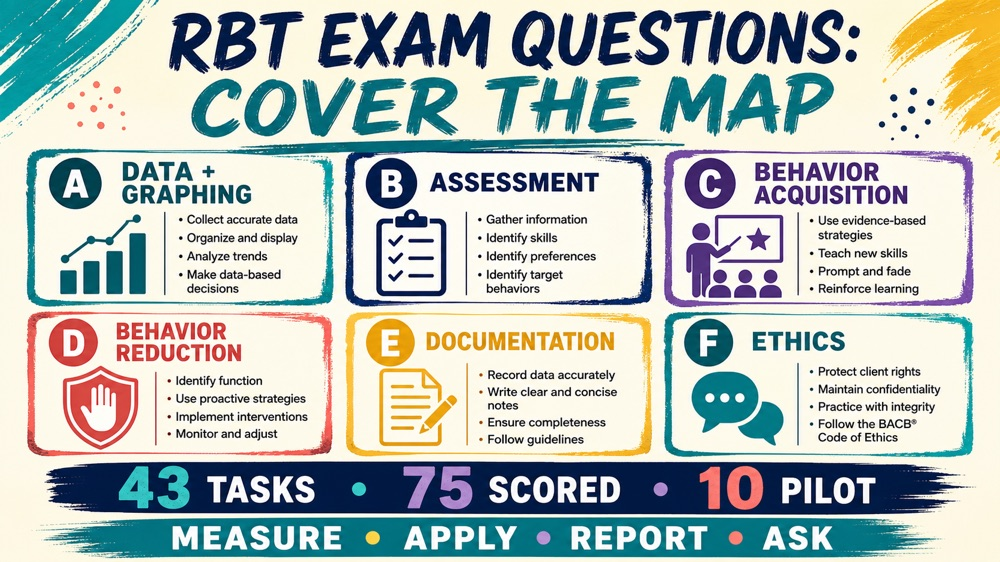
Use the current TCO to audit coverage. The 43 tasks are organized into six content areas. The Handbook’s blueprint gives the following scored-question distribution:
| Domain | Scored share | Question decisions to practice |
|---|---|---|
| A. Data Collection and Graphing | 13 / 17% | Operational definitions, measurement, calculation, graphing, and data quality. |
| B. Behavior Assessment | 8 / 11% | Preference or skill assessment procedures, ABC data, and role limits. |
| C. Behavior Acquisition | 19 / 25% | DTT, naturalistic teaching, prompting, reinforcement, shaping, chaining, maintenance, and generalization. |
| D. Behavior Reduction | 14 / 19% | Antecedent strategies, differential reinforcement, extinction, safety, and fidelity. |
| E. Documentation and Reporting | 10 / 13% | Objective notes, accurate data, privacy, and timely communication. |
| F. Ethics | 11 / 15% | Competence, supervision, dignity, boundaries, confidentiality, and reporting. |
Percentages are a planning map, not a promise about which individual item you will see. A short set can target one domain, but it cannot establish complete readiness. Keep a coverage log so a high number of questions in Domain C does not hide a weak documentation or ethics decision.
Also keep official exam facts separate from a third-party format. The Handbook describes 75 scored questions, 10 unscored pilot questions, four answer choices, and 90 minutes. A practice site may offer 10, 20, 75, 85, or 561 items; its item count does not become an official exam form.
Use a two-pass RBT exam questions routine
Use two passes to separate independent retrieval from explanation:
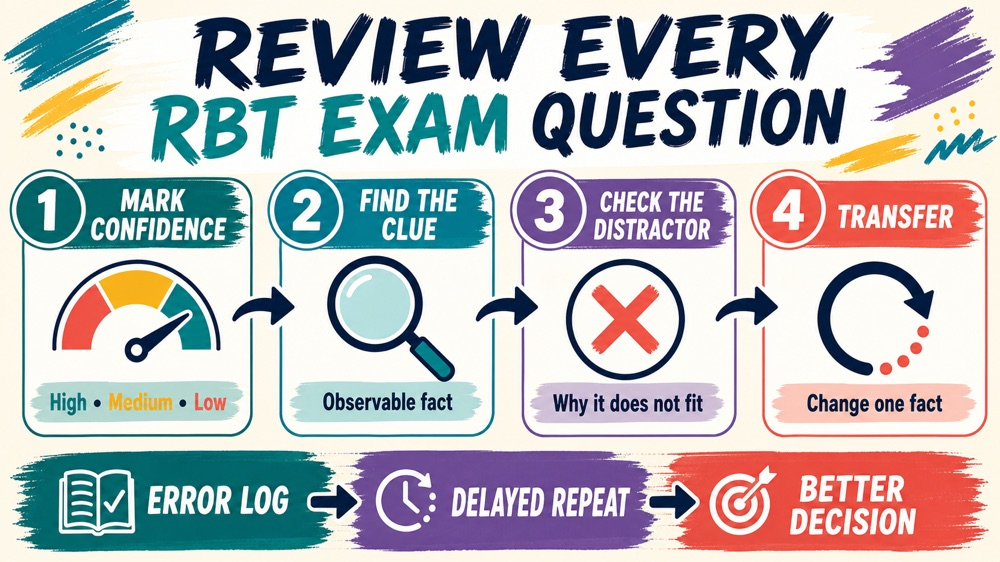
- Pass one—decide: read the stem once, underline the controlling clue, select the best option, and mark confidence as high, medium, or low.
- Pass two—explain: for every missed or low-confidence item, write the task or domain, the fact that controlled the answer, and why the strongest distractor failed.
Do not look up every definition during the first pass. You need one clean sample of your current decision process. Then use the review pass to find whether the problem was vocabulary, measurement, discrimination, calculation, procedure fidelity, documentation, or ethics.
For a 20-item study block, you might spend 25 minutes answering and 35 minutes reviewing. Those times are a study suggestion, not an official exam limit. If you use a full practice set, record whether fatigue or timing changed the quality of your reasoning. The next session should address the process that failed, not only repeat the same questions.
Confidence matters. A correct answer chosen for the wrong reason is a delayed error. Keep a separate line for “correct but low confidence” and schedule a changed scenario later in the week.
Review the distractor, not just the answer
Use a four-column review note:
| Column | Prompt | Example |
|---|---|---|
| Observable clue | What exact fact did the stem provide? | “The response lasted from onset until it stopped.” |
| Best fit | Which concept or procedure matches? | “Duration, because the question asks how long the response continued.” |
| Nearest distractor | Why did the tempting option fail? | “Latency is the delay before onset, not the time after onset.” |
| Transfer item | What changes in a new scenario? | “Use a new behavior and ask for the delay before it begins.” |
Write the rationale in your own words, close the page, and say it aloud. Then change the person, setting, timing, or requested unit. If you can solve only the original wording, you recognized a pattern rather than learned the discrimination.
Be especially careful with wording that changes the action: “most appropriate,” “first,” “best,” “next,” “except,” and “according to the plan” are not decorative words. Mark them before choosing an answer.
Five original RBT exam questions to rehearse
The following mini-prompts are newly written for independent study. They are not official, recalled, leaked, or BACB-endorsed questions. Answer each before reading the rationale.
- Measurement: A client engages in 18 responses during a 30-minute observation, and the question asks for responses per hour. The matching decision is rate: convert the count to the requested time unit. Do not report count alone.
- Assessment: A supervisor assigns a preference procedure with a stated order, but one item is missing. Follow the available written direction and ask how to proceed; do not silently replace the assessment with a different procedure.
- Acquisition: A plan specifies a verbal model before an independent response. Record the prompted response as directed and follow the prompt-fading plan. Do not remove or add prompts solely because another sequence feels faster.
- Reduction: A safety event is not addressed by the written plan. Follow the established safety instructions and contact the responsible supervisor or designated professional. Do not invent a new consequence based on a guess about function.
- Documentation and ethics: A colleague asks whether a recognizable child is a client. The role-safe response protects confidentiality and does not confirm or deny client status. Do not share a story simply because the colleague works in the same field.
For each prompt, name the domain, the clue, the nearest contrast, and the next action. That five-part explanation is more durable than memorizing an answer letter.
Turn missed RBT exam questions into a loop
Use a correction loop rather than unlimited immediate retakes:
- Tag the error: definition, distinction, measurement, calculation, procedure fidelity, documentation, or scope and ethics.
- Write one correction rule: “Check the requested unit before calculating,” or “follow the written plan before considering an escalation.”
- Make one new example: change the behavior, setting, person, timing, or distractor.
- Delay the repeat: revisit tomorrow and later in the week.
- Update coverage: choose the next domain only after the correction survives a changed scenario.
Use an error log with the date, domain, task, confidence, missed clue, correct rule, and next review date. If the same error appears across different question banks, stop adding more items and study the underlying distinction.
Do not let third-party pass thresholds become your certification expectation. An independent site may publish a suggested “pass” percentage, but the official result and requirements are controlled by the BACB and its examination process. Use a practice score to choose what to review, not to make a promise about the outcome.
Avoid practice-question traps
- Calling independent items real: label original questions as independent and newly written.
- Using old domain names without a map: compare older materials with the current 3rd-edition TCO.
- Counting questions as coverage: inspect whether all six domains and decision types appear.
- Reading answer letters only: require a rationale and nearest contrast.
- Ignoring low-confidence correct answers: treat uncertainty as a review signal.
- Practicing only vocabulary: add observable scenarios, procedure choices, documentation, and ethical boundaries.
- Learning to change plans: reinforce implementation, accurate reporting, and supervision routes.
Bottom line: the best RBT exam questions are decision rehearsals. Map them to the current six-domain TCO, mark the clue and confidence, review the strongest distractor, create a changed example, and keep independent practice separate from official BACB requirements.
Ready to review your next decision?
Take a short independent set, mark confidence, and use each explanation to choose a correction target.
Try Free RBT Practice Questions →
Frequently Asked Questions
Are independent RBT exam questions official?
No. Independent practice questions are not official BACB exam forms, recalled items, leaked items, or BACB-endorsed content.
How should I review a missed question?
Record the observable clue, correct concept or procedure, nearest distractor, error type, and a new scenario with one changed fact.
How many RBT exam questions should I practice?
Choose a set that serves your purpose, and sample all six domains over time. A third-party item count does not reproduce the secure exam.
Can a high practice score guarantee that I will pass?
No. A practice score measures performance on that independent resource and cannot guarantee a passing result or certification.
References
- Behavior Analyst Certification Board. RBT Test Content Outline, 3rd edition.
- Behavior Analyst Certification Board. RBT Handbook, updated June 2026.
- Behavior Analyst Certification Board. RBT Ethics Code.