

The RBT exam is the certification examination in the Registered Behavior Technician pathway, but exam preparation is only one part of becoming and staying certified. A reliable plan separates eligibility and training from the initial competency assessment, application, official examination, and later maintenance requirements. It also separates BACB facts from independent practice tests, PDFs, flashcards, and study claims.
Table of Contents
- What the RBT exam is—and what it is not
- Official RBT exam snapshot
- Separate eligibility from exam preparation
- Map the six current exam domains
- Choose the right practice format
- Use scenario reasoning, not answer memory
- Follow a four-stage RBT exam plan
- Prepare for test day within official rules
- Turn practice errors into review actions
- Common RBT exam mistakes
- Frequently Asked Questions
- References
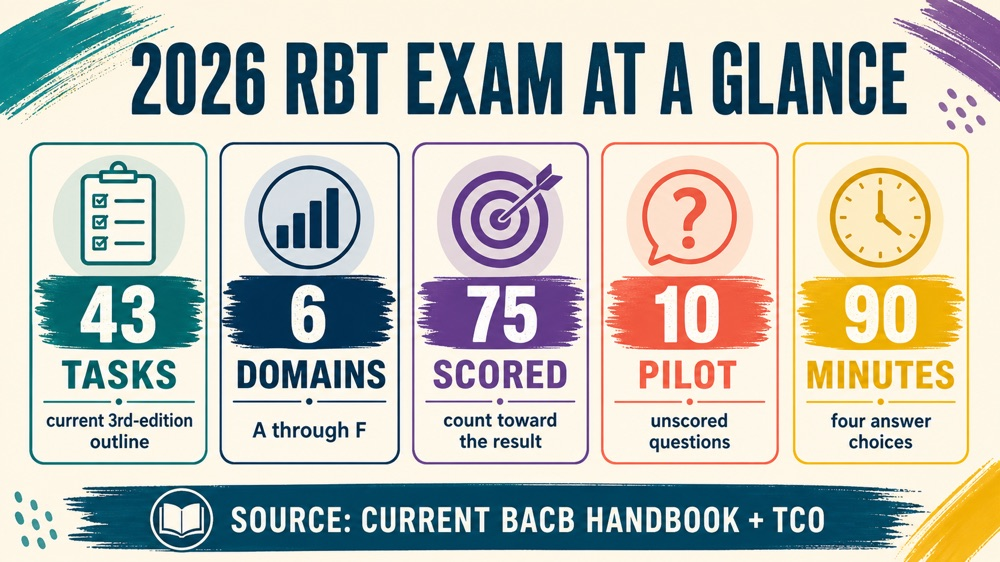
The current RBT Test Content Outline, 3rd edition, describes 43 tasks across six domains. The current examination context includes 75 scored questions and 10 unscored pilot questions, with four answer choices and 90 minutes according to the current BACB Handbook. Verify current requirements and test-day rules in the official Handbook rather than relying on a commercial practice page.
RBT Training is an independent educational resource. It is not affiliated with, operated by, or endorsed by the Behavior Analyst Certification Board (BACB). The examples and study prompts in this article are newly written for independent study. They are not official, current, retired, recalled, leaked, or BACB-endorsed questions. No practice score, study guide, or schedule can guarantee a passing result or certification.
What the RBT exam is—and what it is not
The RBT exam is a certification examination that assesses knowledge and application related to the current RBT Test Content Outline. It is not the 40-hour training itself, not the initial competency assessment, and not the certification application. A learner can be strong in one part of the pathway and still need action in another.
| Pathway stage | Question it answers | What an independent practice set cannot replace |
|---|---|---|
| Eligibility | Do I meet the current requirements to apply? | Use the current BACB Handbook and applicable instructions. |
| 40-hour training | Have I completed required training within the current rules? | A quiz or PDF cannot create a training certificate. |
| Initial competency assessment | Can I demonstrate assigned technician skills? | Multiple-choice accuracy does not prove hands-on competence. |
| Application | Have required documents and attestations been submitted and reviewed? | A practice score does not approve an application. |
| Certification exam | Can I apply current content under examination conditions? | A third-party question is not an official test item. |
This distinction is the first quality check for an RBT exam page. If a resource promises that one mock score predicts certification, it is making a claim that the format cannot support. Use official pages for administrative decisions and independent practice for learning, pacing, and correction.
Official RBT exam snapshot
Use the following snapshot as a study orientation, then verify the current official Handbook before applying or scheduling. Provider pages may use the same numbers while presenting their own product as if it were the exam; the source and status still matter.
| Current exam fact | Study implication | Do not infer |
|---|---|---|
| 43 tasks in the current TCO | Build a map across all six domains instead of studying only familiar vocabulary. | A commercial bank’s task tags are automatically BACB-approved. |
| 75 scored questions | Use the official distribution as a coverage guide for scored-content practice. | A 75-question PDF is the official scored form. |
| 10 unscored pilot questions | Understand the 85-question context and why every item still needs attention. | You can identify which questions are unscored. |
| Four answer choices | Compare every option with the controlling clue and reject the nearest distractor. | The longest or most technical option is correct. |
| 90 minutes | Measure pacing after untimed reasoning is accurate. | A third-party timer or pass line predicts the official result. |
The current official content outline is the scope anchor; the Handbook and examination information pages control requirements, scheduling, accommodations, security, and testing instructions. A blog can explain how to study, but it should not replace those sources.
Separate eligibility from exam preparation
A common search journey begins with “How do I pass the RBT exam?” and then discovers that the reader is actually asking an eligibility question. Start by sorting your next action:
- “Can I apply?” Read the current BACB Handbook, especially education, age, background, training, assessment, and application requirements.
- “What will be tested?” Read the current RBT Test Content Outline, 3rd edition, and map the six domains.
- “Can I perform the skill?” Use supervised training and the initial competency assessment.
- “Can I reason under time pressure?” Use original practice scenarios, a correction log, and later a timed simulation.
Do not treat an exam-prep article as a substitute for application or test-center instructions. Requirements can change, and local employer or training-provider processes may add steps. Use the current official source for an administrative decision, then return to independent practice for concept application.
Map the six current exam domains
The current TCO organizes 43 tasks into six domains. The task ranges below are a practical study map:
| Domain | Task range | Study focus | Controlling question |
|---|---|---|---|
| A. Data Collection and Graphing | A.1–A.8 | Observable definitions, measurement systems, data display, accuracy. | What is measured, in what unit, and how is it summarized? |
| B. Behavior Assessment | B.1–B.3 | Preference and skill assessment, descriptive observation, plan procedures. | What is observed or implemented, and what conclusion requires supervision? |
| C. Behavior Acquisition | C.1–C.11 | Prompting, reinforcement, shaping, chaining, discrimination, maintenance, generalization. | Which teaching step and consequence match the written plan? |
| D. Behavior Reduction | D.1–D.7 | Antecedents, consequences, replacement behavior, reduction and safety procedures. | What does the plan direct, and what should be recorded or reported? |
| E. Documentation and Reporting | E.1–E.4 | Objective notes, data integrity, communication, records. | Could another professional verify the description? |
| F. Ethics | F.1–F.10 | Dignity, privacy, competence, supervision, boundaries, integrity. | Is the action authorized, respectful, and role-safe? |
Use the domain map twice. First, use it to find coverage gaps. Second, use it to classify errors after practice. A missed item about latency is not simply “a wrong answer”; it may be a measurement-unit error. A missed item about a prompt may be a skill-acquisition or role-boundary error. The domain label tells you where to repair.
Choose the right practice format
The search results for the RBT exam contain short quizzes, printable PDFs, domain sets, 75-question sets, 85-question simulations, flashcards, and commercial study guides. Each format answers a different study question:
| Format | Use it when | What to record |
|---|---|---|
| Term or flashcard set | You need first-pass recall and contrast pairs. | Definition, nearest contrast, and confidence. |
| Short diagnostic | You need to discover which domains or concepts need attention. | Domain, error type, and next source. |
| Domain quiz | You are repairing one decision family. | Controlling clue and why the distractor failed. |
| Mixed scenario set | You are testing transfer across domains. | Whether the error was knowledge, reading, or role boundary. |
| Timed simulation | Untimed reasoning is stable and you need pacing evidence. | Time lost to rereading, calculation, uncertainty, or fatigue. |
Before using any resource, check its stated TCO edition, source references, answer explanations, privacy terms, and security language. Avoid any resource that claims to reproduce real, current, recalled, leaked, or BACB-endorsed questions. Practice should build transferable reasoning, not dependence on memorized wording.
Use scenario reasoning, not answer memory
Most learners do not need more answer-letter exposure; they need a way to locate the clue that changes the decision. Use this five-step method:
- Name the requested decision: measurement, assessment procedure, teaching step, reduction response, documentation, or ethics action.
- Underline the controlling clue: a time unit, written plan, prompt condition, observable event, or reporting relationship.
- Predict the rule: say what should happen before scanning the options.
- Reject the nearest distractor: identify the condition it changes, ignores, or assumes.
- Check role and source: select the objective, plan-based, supervision-safe response.
For example: a learner engages in 10 target responses during a 20-minute observation. The answer to a frequency question is 10; the answer to a rate-per-hour question is 30; a duration answer requires onset and offset data. The controlling clue is the requested unit, not the behavior label.
For another example: an RBT sees that a prompt in the written plan no longer appears effective. The role-safe answer is to record the observation and contact the supervisor through the established route, not to invent a new prompt hierarchy or rewrite the goal in the moment.
Follow a four-stage RBT exam plan
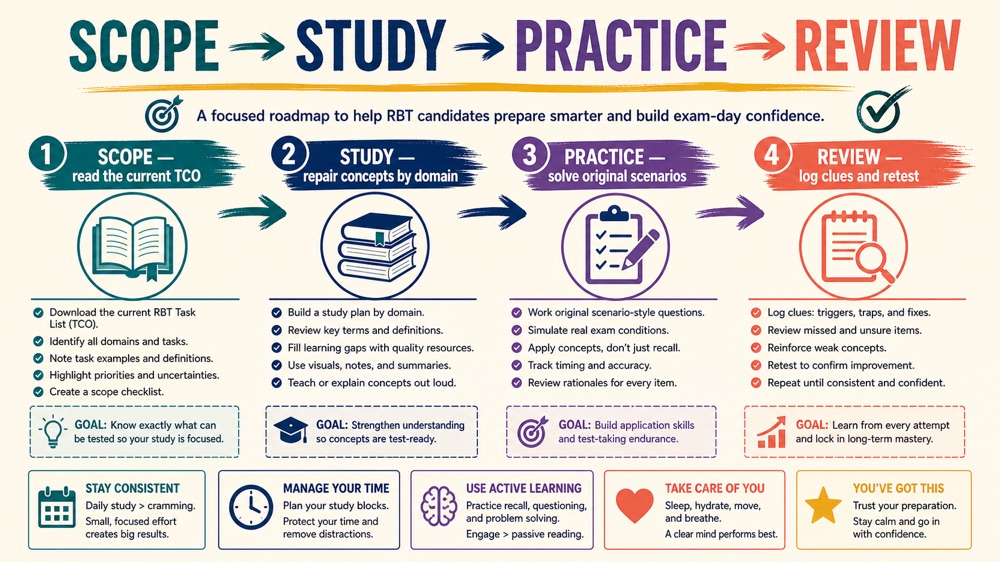
A staged plan keeps a broad exam keyword from becoming an unfocused list of resources:
| Stage | Goal | Exit evidence |
|---|---|---|
| 1. Scope | Read the current TCO and Handbook; create an A–F map and mark administrative questions. | You can state what belongs to official sources and what belongs to practice. |
| 2. Repair | Study concepts by domain, definition, contrast, and original example. | You can explain why the nearest distractor fails. |
| 3. Transfer | Use mixed scenario sets and record confidence, clue, role, and error type. | Accuracy holds when the context or wording changes. |
| 4. Simulate | Use timed practice, then analyze pacing and errors rather than chasing a score. | You have a correction plan for the next session and official test-day rules verified. |
Some learners need more time in Stage 1 because eligibility or edition confusion is unresolved. Others need more Stage 3 because they can define terms but miss application clues. Let the evidence choose the next stage instead of moving to a full simulation simply because an 85-question button is available.
Prepare for test day within official rules
Use the current BACB and Pearson VUE instructions for appointment scheduling, identification, accommodations, testing-center requirements, prohibited items, and what happens if an appointment changes. These details are time-sensitive and should not be copied from an old study guide.
For study purposes, rehearse three behaviors:
- Read the full stem: do not answer from the first familiar word.
- Manage the clock: notice when time is lost and use a reasoned return strategy if the interface permits.
- Protect exam security: do not seek or share current, recalled, leaked, or answer-dump content.
A practice timer is a measurement tool, not a prediction. A practice score is evidence under one provider, one item set, and one condition. Neither substitutes for official test-day instructions or guarantees a result.
Turn practice errors into review actions
After every practice round, use a correction log with six fields:
- Domain and task family: A–F and the narrow concept.
- Controlling clue: the time unit, response feature, plan instruction, or ethical issue.
- Chosen answer: what you selected before feedback.
- Nearest distractor: why it sounded plausible.
- Error type: definition, measurement, application, reading, pacing, or role boundary.
- Next retest: a changed scenario, source reread, contrast card, or domain set.
Do not erase guessed correct answers. A correct answer with low confidence is a repair signal, just as an incorrect answer with a clear explanation may be a simple reading slip. Track confidence so your review plan measures knowledge stability rather than only percentage correct.
Common RBT exam mistakes
- Using a practice page as the official authority: use the current BACB TCO and Handbook for scope and process.
- Confusing 85 total with 75 scored: remember the current 75 scored and 10 unscored pilot context.
- Studying only the largest domain: use the six-domain map and repair smaller areas too.
- Starting with a timed mock too early: build untimed reasoning before using pacing as a test.
- Memorizing answer letters: record the clue and distractor boundary instead.
- Calling third-party items real: independent questions are not official, current, recalled, leaked, or endorsed items.
- Ignoring administrative steps: exam prep does not replace eligibility, training, assessment, application, or test-day instructions.
- Treating a practice score as a guarantee: use it to choose a next action, not to promise certification.
Bottom line: Prepare for the RBT exam by starting with current BACB sources, mapping the 43-task six-domain scope, separating the official test from independent practice, and moving from concept repair to mixed scenarios, timed evidence, and correction-based retesting. This approach makes a broad search term actionable without confusing a study product with the certification process.
Ready for the next practice round?
Use current-domain practice questions, log the controlling clue, and turn every correction into a focused review action.
Try Free RBT Practice Questions →
Frequently Asked Questions
What is the RBT exam?
It is the BACB certification examination that assesses knowledge and application related to the current RBT Test Content Outline. It is one stage of the certification pathway and is separate from training, the initial competency assessment, and the application.
How many questions are on the current RBT exam?
The current BACB Handbook states that the examination includes 75 scored questions and 10 unscored questions, for 85 questions in the exam context. Candidates have 90 minutes and each question has four possible answers with one correct answer.
What does the current RBT exam cover?
The current RBT Test Content Outline, 3rd edition, describes 43 tasks across Data Collection and Graphing, Behavior Assessment, Behavior Acquisition, Behavior Reduction, Documentation and Reporting, and Ethics.
Should I start with an 85-question mock?
Start with a mock when you can reason accurately without a timer. Before that, use domain review, definitions, short diagnostics, and original scenarios so the timed result tells you something useful.
Are RBT practice questions official?
Independent practice questions are not official BACB items. They should not claim to contain current, recalled, leaked, retired, or BACB-endorsed questions. Use them for learning, application, pacing, and corrections.
Can an RBT practice score guarantee that I will pass?
No. A practice score reflects one item set and one condition. It cannot guarantee certification, a passing result, or performance on the official examination.
References
- Behavior Analyst Certification Board. RBT Test Content Outline, 3rd edition.
- Behavior Analyst Certification Board. RBT Test Content Outline, 3rd-edition PDF.
- Behavior Analyst Certification Board. RBT Handbook.
- Behavior Analyst Certification Board. Examination Information.
- Independent RBT practice-exam hub. Reviewed for competitor research; not an endorsement.
- Independent RBT practice sampler. Reviewed for competitor research; not an endorsement.
- Independent RBT practice-resource page. Reviewed for competitor research; not an endorsement.