
RBT flashcards free resources work best when each card includes a current source, a plain-language definition, an observable example, and a role boundary. A colorful deck is not enough if it preserves an outdated claim or only tests recognition. This page is an independent study aid, not an official BACB flashcard set or answer key.
Table of Contents
- Build an RBT flashcards free source log
- Use a five-part flashcard format
- Make measurement cards
- Make acquisition and reduction cards
- Make documentation and ethics cards
- Use RBT flashcards free for active recall
- Keep a card deck current
- Avoid flashcard mistakes
- RBT flashcards free checklist
- Frequently Asked Questions
- References
Continue your RBT study with RBT exam study materials and original practice resources.
Quick answer: Treat rbt flashcards free as a current-source RBT study topic. Define the concept, connect it to an observable action, use original examples, and keep the supervision boundary visible.
Study boundary: This independent guide is educational content. It is not a BACB policy, certification decision, legal opinion, answer key, or guarantee of examination success. It does not promise a passing score or certification outcome. Examples are original and are not official, recalled, leaked, or BACB-endorsed questions.
Current exam context: The current BACB RBT Test Content Outline describes 43 tasks across six domains; the examination includes 75 scored questions and 10 unscored pilot questions in a 90-minute testing period. Verify the current handbook and outline before relying on a time-sensitive detail.
Build an RBT flashcards free source log
Record the current RBT Test Content Outline, Handbook, and Ethics Code with version dates and official URLs before making cards. Add a check date to every card set. The source line helps you update a definition instead of trusting a screenshot that may no longer apply.
Keep one card focused on one decision. Add a note when the written program or supervision controls the exact procedure.
Use a five-part flashcard format
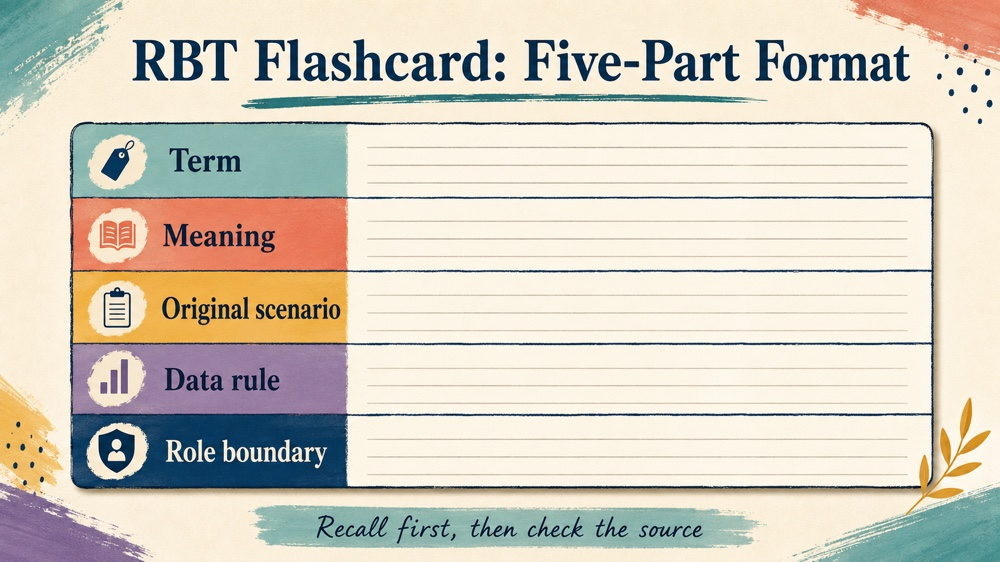
A useful card has the term, plain-language meaning, original scenario, data or teaching implication, and role boundary. The back should not reveal a solution before the learner has explained the condition. This format supports recall and application together.
- Read the term or scenario.
- Answer from memory.
- Explain the observable action.
- Check the source.
- Create a new example after a miss.
Make measurement cards
Create cards for frequency, rate, duration, latency, interval recording, permanent product, percentage, graphing, baseline, and data integrity. Include start and stop rules or a small timeline. A card should show what one mark represents and what it does not establish.
When a measure depends on the operational definition, say so. Do not use a flashcard to authorize a convenient substitute measure.
Make acquisition and reduction cards
Include reinforcement, prompting, fading, shaping, chaining, discrimination, generalization, maintenance, antecedent strategies, differential reinforcement, extinction, safety, and reporting. Pair the concept with an original condition and the RBT action. Keep clinical design decisions outside the card’s authority.
Use near-neighbor cards that differ by one fact. This helps the learner choose a rule from the scenario rather than from a keyword.
Make documentation and ethics cards
Include objective note, confidentiality, competence, supervision, accurate record, professional conduct, and reporting. Use fictional situations and minimal facts. Ethics cards should ask what is communicated, protected, or escalated, not only what a word means.
Review every card for an unsupported interpretation or identifying detail. Replace it with an observable fact and a proper communication route.
Use RBT flashcards free for active recall
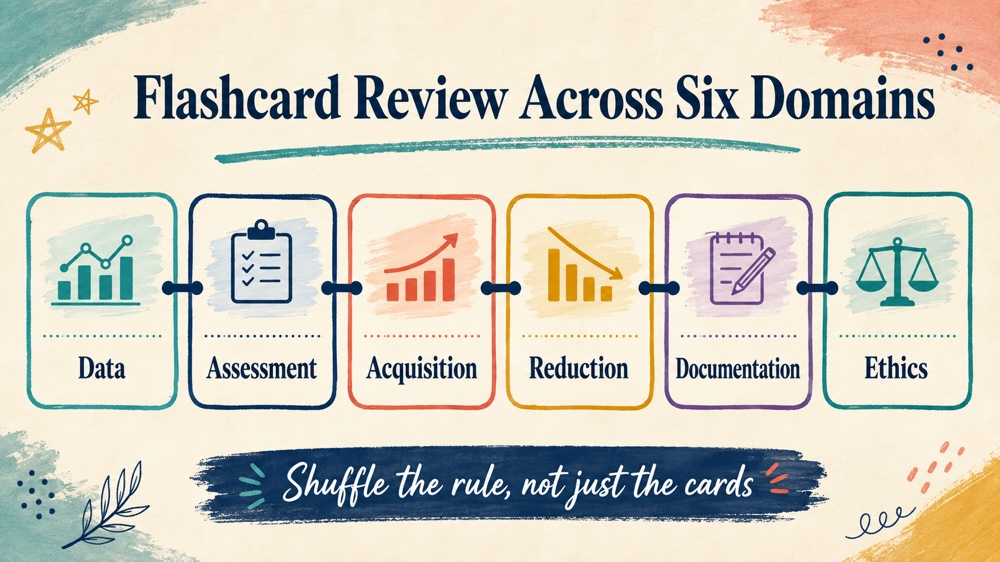
Shuffle by domain, hide the answer, speak the definition, and write a new scenario after a miss. Tag errors as vocabulary, measurement, application, documentation, ethics, or role boundary. Schedule difficult cards for delayed review rather than repeating them immediately.
The current examination includes 75 scored questions and 10 unscored pilot questions in a 90-minute testing period. Verify current BACB materials before using time-sensitive details in a study schedule.
Keep a card deck current
Maintain a source log with the date checked, update needed, and affected cards. Remove duplicates, mark ambiguous local terms, and keep original examples distinct from official sources. A small maintained deck is more useful than a large undated collection.
If a card conflicts with the written program, the program and supervision control the service action. The card should become a prompt to verify, not a reason to improvise.
Avoid flashcard mistakes
- Using an undated third-party deck as current.
- Testing recognition without application.
- Leaving out data, privacy, or supervision.
- Treating a term as authorization to change a plan.
- Including client-identifying details.
- Copying recalled or protected questions.
- Failing to update cards when official sources change.
RBT flashcards free checklist
- Does every card have a source and check date?
- Does it include an original scenario?
- Are measurement rules and examples precise?
- Are all six domains represented?
- Is the RBT role boundary visible?
- Are cards privacy-safe and independent?
- Do misses lead to delayed recall and a new example?
Use RBT flashcards free as a source-linked active-recall system. Keep each card focused, original, updateable, and bounded by the written plan and supervision. RBT Training is independent educational content and is not affiliated with or endorsed by BACB.
Practice the concept
Review rbt flashcards free with original RBT scenarios, current-source reminders, and clear role boundaries.
Review the RBT study resource →
Frequently Asked Questions
What should an RBT flashcard contain?
Use a term, plain-language meaning, original scenario, data or teaching implication, and role boundary.
Can free flashcards replace practice questions?
No. Pair recall cards with original scenarios that require application and explanation.
How do I keep a deck accurate?
Record source dates and revisit cards when current BACB materials or the written program change.
Can cards include recalled questions?
No. Use original examples that are not official, recalled, leaked, or BACB-endorsed.
References
- Behavior Analyst Certification Board: Registered Behavior Technician Handbook, updated June 2026.
- Behavior Analyst Certification Board: RBT Test Content Outline (3rd ed.).
- Behavior Analyst Certification Board: RBT resources.
- Behavior Analyst Certification Board: ethics resources.
- Behavior Analyst Certification Board: RBT Ethics Code (2.0).