
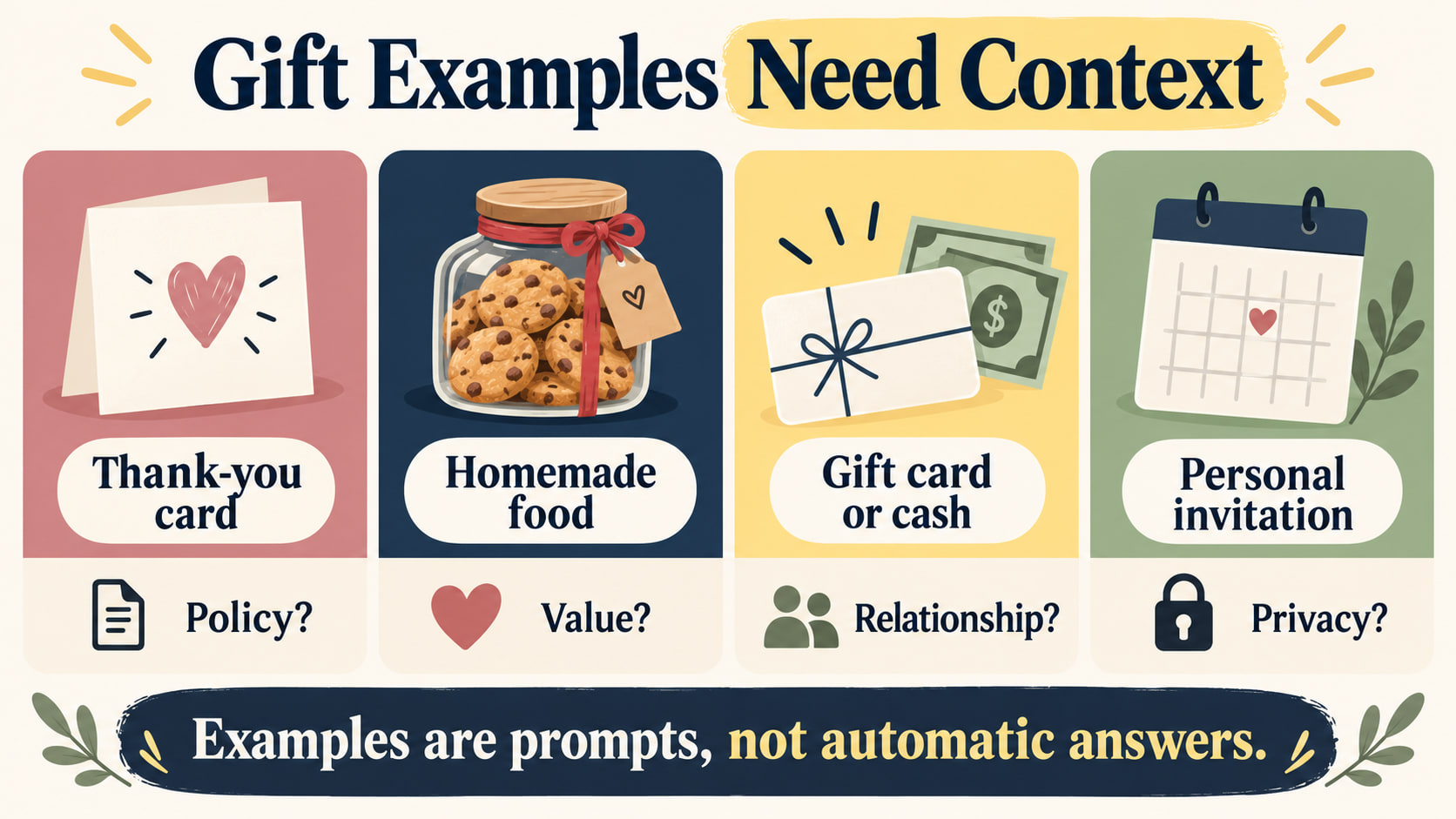
RBT gift examples are useful when they help you practice a decision process rather than memorize a yes-or-no list. A thank-you card, homemade food, gift card, personal invitation, or small token can raise different questions depending on policy, value, timing, relationship, privacy, and the effect on professional boundaries. When a gift is offered, pause, check the applicable rule, and ask the supervisor before responding.
Table of Contents
- RBT gift examples: the short answer
- A context-first decision process
- Practical gift examples
- How to respond in the moment
- When to document and escalate
- Frequently asked questions
RBT gift examples, ethical scenarios, policy checks, supervisor questions, and respectful responses
RBT Gift Examples: Ethical Scenarios and Better Responses
Practice a context-first response to common gift offers without turning one item into a universal yes-or-no rule.
RBT gift examples are useful when they help you practice a decision process rather than memorize a yes-or-no list. A thank-you card, homemade food, gift card, personal invitation, or small token can raise different questions depending on policy, value, timing, relationship, privacy, and the effect on professional boundaries. When a gift is offered, pause, check the applicable rule, and ask the supervisor before responding.
The current ethics code and the employer’s policy are the starting points. Culture and family traditions may also matter, but cultural respect does not remove the need to protect the professional role. If you are unsure, a brief pause and a supervisor question are safer than an instant promise.
RBT gift examples: the short answer
Do not ask only, “Is this item small?” Ask:
- What is the policy? Which current ethics and employer rules apply?
- What is the context? Who offered it, when, why, and in what setting?
- What is the value and effect? Could it create pressure, favoritism, expectation, or a change in the relationship?
- What protects privacy? Would accepting, photographing, transporting, or discussing it expose private information?
- Who should decide? What does the responsible supervisor or organization direct?
A context-first decision process
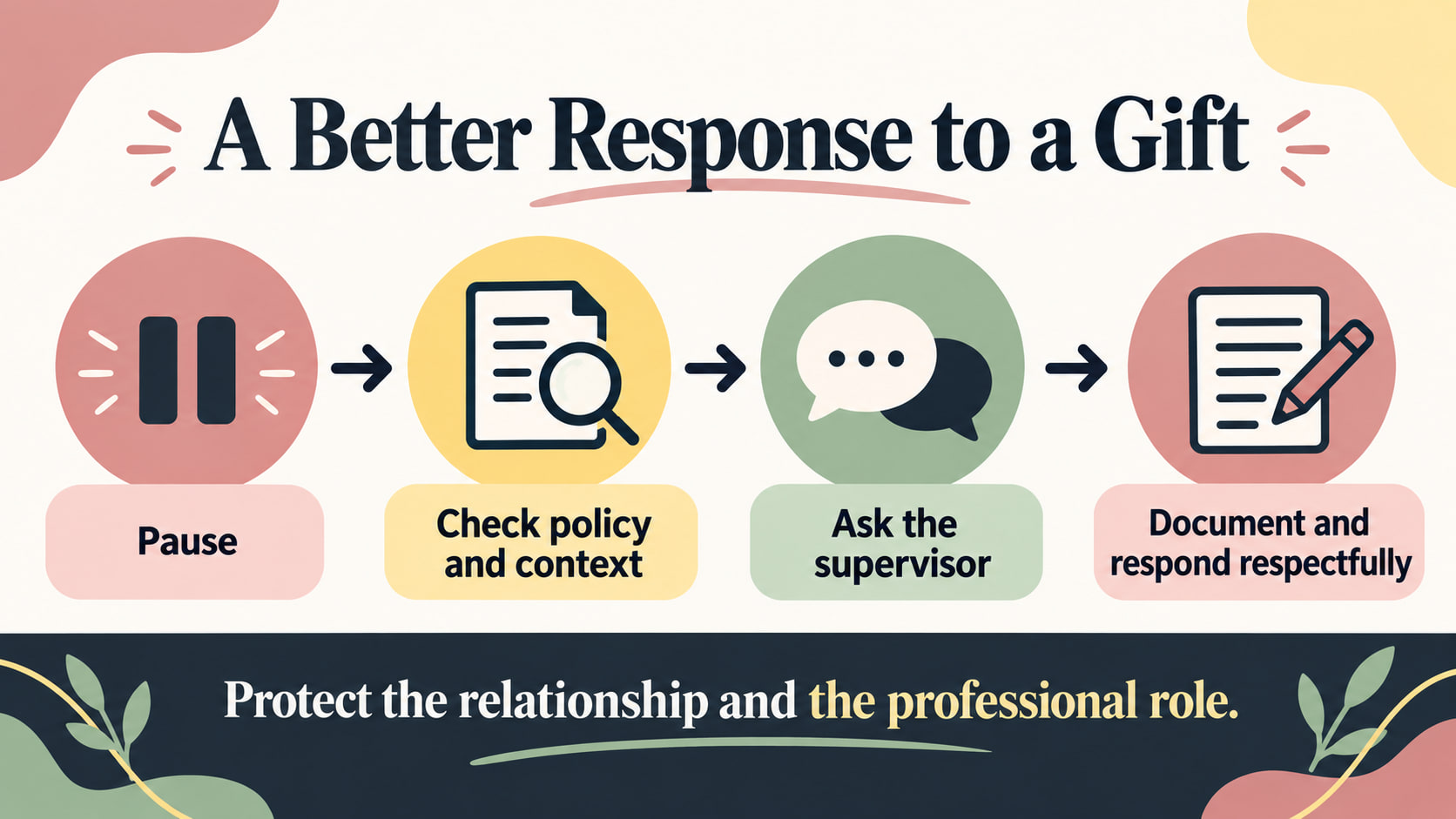
Pause before accepting or refusing. A family may be offering something sincerely, and a fast reaction can make the interaction more uncomfortable. Thank the person for the thought, avoid promising an outcome, and say that you need to check the policy or ask your supervisor.
Check the sources. Look at the current ethics guidance, employer policy, and any setting-specific instruction. Do not rely on a colleague’s memory or a rule copied from another organization. If the sources do not answer the situation, escalate the question.
Consider the relationship and effect. A gift can change expectations even when it has little monetary value. Ask whether it could affect impartiality, create a special arrangement, blur personal and professional contact, or make the learner or family feel they must provide something to receive good service.
Use the approved response. The answer may be to accept under a documented policy, decline kindly, return it, redirect it to an organizational process, or ask for further guidance. The correct response depends on the actual rule and context.
Practical gift examples
1. A handwritten thank-you card
A card may feel different from money or a personal item, but do not assume that every card can be kept in every setting. Check policy, consider whether it includes private information or a personal invitation, and ask how the organization handles it. A respectful response might be: “Thank you for thinking of me. I want to follow our policy, so I’ll check with my supervisor about the best way to handle this.”
2. Homemade cookies or a family meal
Food raises questions about value, health, allergies, sharing, storage, and whether the item is intended for one person or the entire team. It can also create a recurring expectation. Do not transport or share food in a way that exposes private information or violates workplace rules. Ask the supervisor before deciding whether the organization has an approved way to handle it.
3. A gift card, cash, or digital payment
Money-like gifts deserve prompt clarification because they can create a stronger financial boundary concern. Do not accept a transfer and decide later. Thank the person, explain that you need to follow professional policy, and contact the supervisor or designated administrator. Keep the conversation factual and do not negotiate a private alternative.
4. A small holiday or birthday item
A mug, ornament, keychain, or other small token may still have context. Ask whether the timing, repeated pattern, relationship, or personal message changes the concern. A low price does not automatically settle the question. Follow the policy and document or report the decision through the approved route.
5. An invitation to dinner, a party, or a private event
An invitation may be a relationship boundary issue even when no physical gift is exchanged. Do not accept private social contact, personal transportation, or an invitation that moves the relationship outside the professional setting without direction. Offer a neutral thank-you and refer the question to the supervisor.
6. An item intended for the learner or the whole team
A family may offer materials, snacks, or a donation for shared use. Clarify ownership, storage, safety, privacy, and whether the item is approved for the learner or setting. Do not promise that a donated item will be used, and do not take it home or use it privately unless the organization specifically authorizes that arrangement.
How to respond in the moment
A simple script can keep the interaction warm and bounded:
- “Thank you for thinking of me.”
- “I want to follow our professional and workplace policy.”
- “Let me check with my supervisor before I decide how to handle it.”
- “I’ll follow up through the approved channel.”
If the gift is declined, decline the item rather than judging the person: “I appreciate the thought, but I’m not able to accept personal gifts in this role.” If the person is disappointed, remain calm and repeat the boundary. Do not explain confidential information about another client, another employee, or a private policy discussion.
When to document and escalate
Use the organization’s process when a gift is refused, accepted under a policy, returned, redirected, repeated, unusually valuable, connected to a request, or likely to affect the professional relationship. Record only the necessary facts: what was offered, when, the relevant policy question, who was consulted, and the direction received. Do not put unnecessary identifying details in an informal message.
Escalate immediately if the offer includes money, a request for special treatment, private contact, access to confidential information, a threat, pressure, or a safety concern. Escalation is not an accusation. It is a way to obtain consistent direction and protect everyone involved.
Frequently asked questions
What are common RBT gift examples?
Common scenarios include thank-you cards, homemade food, small holiday items, gift cards, cash, personal invitations, and items offered for the learner or team. Each requires context and policy review rather than an automatic answer.
Can an RBT accept a small gift?
Do not decide from size alone. Check the current applicable ethics and employer policy, consider the relationship and effect, and ask the responsible supervisor when the answer is unclear.
What should an RBT say when declining?
Thank the person for the thought, state that professional policy does not allow you to accept personal gifts, and avoid blaming or shaming the person. Ask the supervisor if a different organizational response is needed.
Should a gift situation be documented?
Follow the organization’s process. Documentation is especially important for repeated, valuable, money-like, conditional, private, or boundary-sensitive offers, and whenever a supervisor provides direction.
Role reminder: This is educational ethics information, not individualized clinical, employment, legal, or credentialing advice. Check the current applicable code and employer policy and ask the responsible supervisor about a specific gift situation.
Official starting points: the BACB ethics code, RBT page, RBT Handbook, and supervision and training resources.
Ready to practice the RBT concepts you just reviewed?
Try an independent, original RBT practice resource with exam-style questions, scoring, and answer explanations.
References
- Behavior Analyst Certification Board. RBT Test Content Outline, 3rd edition.
- Behavior Analyst Certification Board. RBT Handbook.
- Behavior Analyst Certification Board. RBT Ethics Code.