
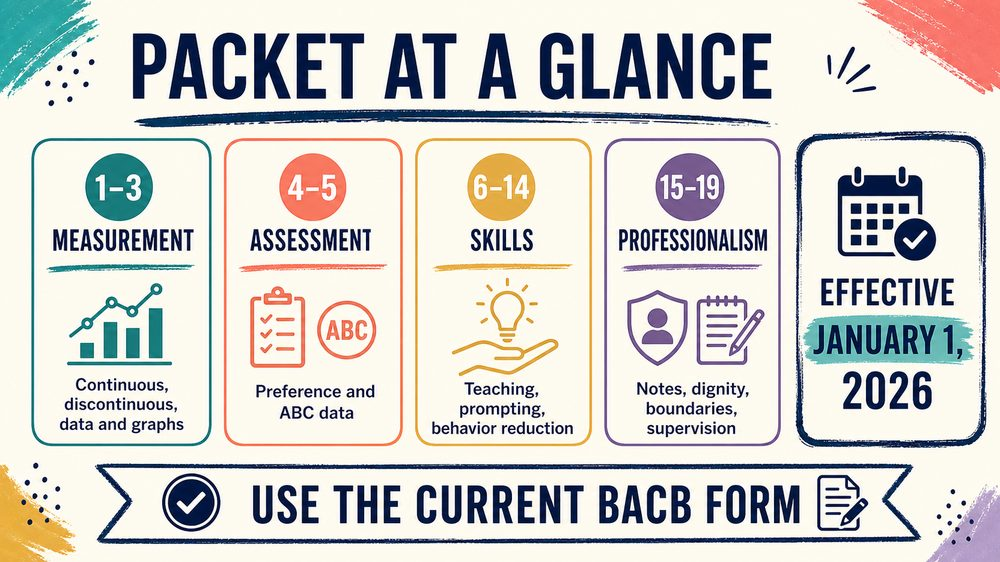
The RBT Initial Competency Assessment Packet is the form and instruction set used to document an applicant’s initial competency assessment. It is not the RBT exam, a study guide, or a generic checklist. The current packet is effective January 1, 2026, and it should be read before relying on older videos, PDFs, or employer templates.
Table of Contents
- RBT initial competency assessment packet: use the current version
- RBT initial competency assessment packet: timing, format, and assessment types
- Read the 19 tasks by section
- Applicant preparation checklist
- Assessor and documentation responsibilities
- What happens when a task needs more practice?
- Common mistakes with the packet
- Original packet-preparation scenarios
- Frequently Asked Questions
- References
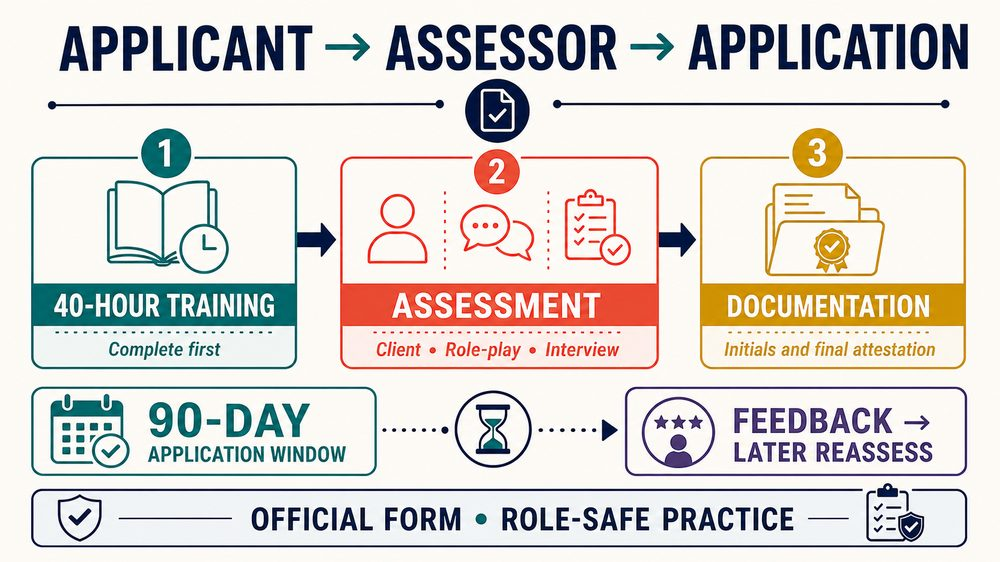
The packet says that all 19 task items must be completed. The assessment follows completion of the 40-hour training and cannot be completed more than 90 days before submitting an RBT certification application. The current RBT Test Content Outline, 3rd edition, separately describes 43 tasks across six domains; the exam frame separately includes 75 scored questions and 10 unscored pilot questions. This article is independent information, not an official BACB form, assessment, certification program, recalled item, leaked item, or guarantee.
RBT initial competency assessment packet: use the current version
Start with the BACB packet, not a search snippet. Confirm the effective date, read the requirements pages, and keep the official form available for the assessment. A third-party study sheet can help you organize practice, but it cannot replace the form. The current packet states that non-BACB forms will not be accepted.
| Source | Use it for | Do not use it for |
|---|---|---|
| Current BACB packet | Task wording, assessment types, timing, assessor rules, and attestation. | Replacing current employer or application instructions. |
| RBT Handbook | Certification process, supervision, renewal, and applicant responsibilities. | Assuming a remembered older deadline is current. |
| RBT TCO 3rd edition | Exam blueprint and six-domain study alignment. | Substituting exam questions for performance assessment. |
| Independent study resources | Rehearsing concepts and fictional examples. | Calling any item official, recalled, or guaranteed. |
If you are searching for the RBT initial competency assessment packet because someone sent an older PDF, compare its effective date and task structure with the current BACB source before using it.
RBT initial competency assessment packet: timing, format, and assessment types
The current packet says the assessment may occur over one or more sessions. It may be conducted in person, live via the internet, or through recorded videos created specifically for assessment. The assessor selects the method permitted for the task and evaluates whether the applicant performed competently.
- With a client: the assessor observes the applicant performing the task with a client receiving behavior-analytic services.
- Role-play: the assessor observes a situation similar to a client interaction when a client demonstration is not used or permitted for that task.
- Interview: the assessor conducts a live interview in which the applicant describes concepts, examples, nonexamples, or decisions.
Three tasks in the Skill Acquisition and Behavior Reduction section must be demonstrated with a client. Read the exact task instructions and let the responsible assessor determine the assessment plan; do not assume that a video or role-play can replace every client demonstration.
Read the 19 tasks by section
| Section | Task numbers | What the packet covers |
|---|---|---|
| Measurement | 1–3 | Continuous measurement; discontinuous measurement; data and graphs. |
| Assessment | 4–5 | Preference assessments; ABC data. |
| Skill Acquisition and Behavior Reduction | 6–14 | Discrete-trial teaching, naturalistic teaching, chaining, shaping, discrimination training, prompting, token systems, crisis/emergency procedures, and one selected procedure. |
| Professionalism and Requirements | 15–19 | Session notes, client dignity, professional boundaries, supervision requirements, and clinical direction. |
For task 14, the packet provides a choice among antecedent interventions, differential reinforcement, and extinction. The current form and assessor instructions control which option is demonstrated. Do not practice extinction or crisis procedures from an unverified internet script.
Applicant preparation checklist
- Verify prerequisites: confirm that the 40-hour training is complete and that the assessment timing fits the application window.
- Read every task statement: write the observable performance, likely assessment type, and question to ask if a term is unclear.
- Practice with direction: rehearse the procedure with an authorized trainer or assessor; do not create an independent client intervention.
- Prepare examples: for interview tasks, build fictional examples and nonexamples that show dignity, boundaries, supervision, and clinical direction.
- Check documentation: know where the official form is stored, who initials each item, and who signs the final attestation.
- Protect privacy: use only approved records, systems, video processes, and client permissions.
Practice the behavior, not just the label. For measurement, rehearse the start and stop events. For prompting, rehearse timing and fading. For session notes, rehearse observable language. For clinical direction, rehearse how you will report uncertainty before changing the plan.
Assessor and documentation responsibilities
The packet distinguishes a responsible assessor from possible assistant assessors. The responsible assessor must meet the current credential, 8-hour supervision-training, organizational relationship, record-retention, and oversight requirements described in the packet. The responsible assessor remains responsible for ensuring that the assessment is conducted and documented according to the requirements, even when assistants complete portions.
- The assessor provides an opportunity for each task and evaluates competent performance.
- After a task is demonstrated competently, the assessor initials the item and marks the assessment type used.
- After all tasks are complete, the responsible assessor signs and dates the final attestation.
- The responsible assessor maintains assessment documentation for the period required by the current packet.
- The completed packet is submitted with the certification application according to current BACB instructions.
An applicant should ask who is responsible for the form and where questions go, but should not alter assessor initials, signatures, dates, or task records.
What happens when a task needs more practice?
If an applicant does not demonstrate competence, the packet permits corrective feedback and assessment on another day. The process is repeated until competence is demonstrated. Corrective feedback may not be delivered on the final assessment of a task. This makes the assessment a performance-and-feedback process, not a single stressful performance with no opportunity to learn.
For example: an applicant uses a verbal prompt at the wrong point in a teaching procedure. The assessor can identify the timing issue, arrange another opportunity, and evaluate the corrected performance later. The applicant should record the feedback as a specific practice target rather than memorizing “be more careful.”
Common mistakes with the packet
| Mistake | Why it creates risk | Better action |
|---|---|---|
| Using an old form | Task wording, effective dates, or requirements may differ. | Start with the current BACB packet. |
| Treating it like the exam | Knowing a definition does not demonstrate performance. | Rehearse observable steps and interview examples. |
| Assuming role-play replaces every client task | The packet specifies client demonstrations for three skill tasks. | Follow the task instructions and assessor plan. |
| Signing before competence is shown | Initials and attestation document completed performance. | Let the assessor complete the form after observation. |
| Changing a procedure during practice | Unapproved improvisation can create safety and fidelity problems. | Pause and seek direction. |
Original packet-preparation scenarios
Scenario 1—timing: an applicant finished the 40-hour training but wants to complete the assessment nine months before applying. Check the current packet and application timing instead of relying on a course video.
Scenario 2—documentation: an assistant assessor initials a task before observing competent performance. Pause and route the issue to the responsible assessor; do not treat an incomplete form as finished.
Scenario 3—interview: an applicant describes dignity as “being nice” but cannot give an example. Rehearse a concrete privacy, communication, choice, or respectful-language example.
Scenario 4—client safety: a role-play script conflicts with a client’s written safety protocol. Do not use the script as authority; follow the current plan and ask the responsible supervisor or assessor.
These are newly written independent study examples, not official, recalled, leaked, or BACB-endorsed assessment items.
Bottom line: the RBT initial competency assessment packet is the authority for the current 19-task performance assessment. Read the effective date, follow the permitted assessment type, practice with feedback, protect privacy, and let the responsible assessor complete the official documentation. Completion alone does not guarantee certification approval.
Prepare the reasoning behind each task.
Review original RBT scenarios across measurement, assessment, teaching, documentation, supervision, and ethics.
Try free RBT practice questions →
Frequently Asked Questions
Where can I find the current packet?
Use the current RBT Initial Competency Assessment Packet on the BACB website and verify its effective date. Do not rely on an undated copy or an older third-party form.
How many tasks are in the packet?
The packet effective January 1, 2026 lists 19 task items, all of which must be completed.
Can the assessment happen online?
The packet permits in-person, live internet, and purpose-created recorded-video formats where the task instructions allow them. The assessor determines the permitted method.
Does the packet replace the RBT exam?
No. The initial competency assessment and the RBT exam are separate parts of the certification process.
Does passing the packet guarantee certification?
No. The packet is one requirement. Application, background, exam, and other current BACB requirements still apply.
References
- Behavior Analyst Certification Board. RBT Initial Competency Assessment Packet: Effective January 1, 2026.
- Behavior Analyst Certification Board. RBT Handbook.
- Behavior Analyst Certification Board. RBT Test Content Outline (3rd ed.).
- Behavior Analyst Certification Board. Ethics Codes and RBT Ethics Code (2.0).
- RBT competency assessment guide. Reviewed for competitor research; not an endorsement.