
Searching for an RBT mock exam PDF is easy. Choosing one that is current, independent, readable, and useful for review is harder. A download is only a file; a good practice resource should help you simulate a timed attempt, explain why an answer is best, and show which domain or decision rule needs another pass.
Table of Contents
- What an RBT mock exam PDF should do
- Check the edition and question count
- Audit the PDF before you study
- Use the PDF in two modes
- Review answers by decision rule
- Build a domain-based correction log
- Practice RBT mock exam PDF decisions
- Avoid these RBT mock exam PDF mistakes
- Frequently Asked Questions
- References
This guide gives you a practical way to evaluate an RBT mock exam PDF against the current RBT Test Content Outline, 3rd edition. It also explains the difference between a practice PDF and official BACB material, how to use a PDF in study mode or exam mode, and how to turn errors into a next-step plan.
RBT Training is independent and is not affiliated with, operated by, or endorsed by the Behavior Analyst Certification Board (BACB). All examples and practice prompts below are newly written for independent study. They are not official, recalled, leaked, or BACB-endorsed questions. No PDF, score, course, or study schedule can guarantee a passing result.
What an RBT mock exam PDF should do
A useful practice PDF should simulate enough of the decision work to expose gaps. It should not simply repeat definitions in a long list. Look for scenario wording, plausible distractors, answer rationales, and a way to record which topic caused the error.
| Resource feature | Why it matters | What to verify |
|---|---|---|
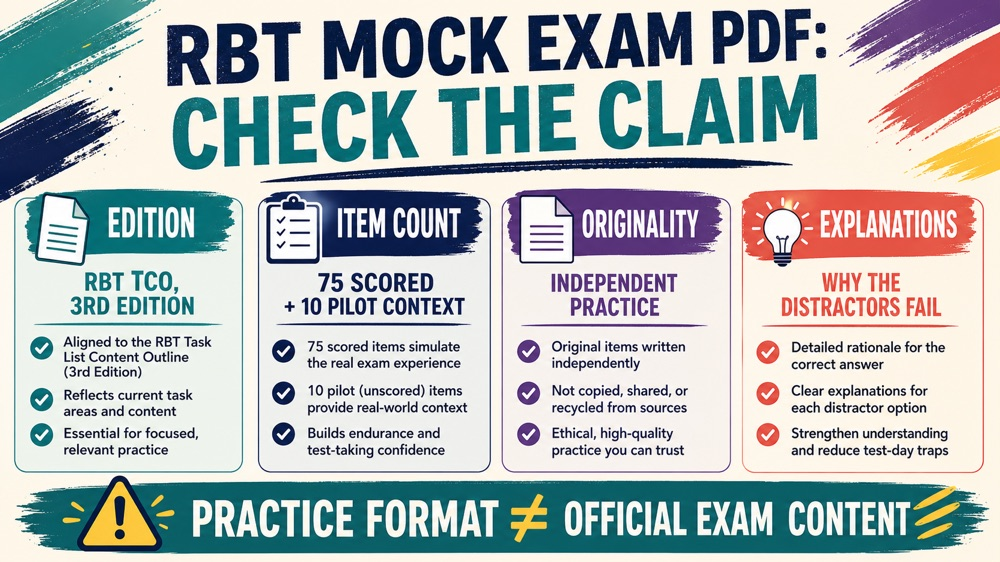
| Current edition statement | Old task-list language can point study toward outdated emphases. | Does the resource name the RBT TCO, 3rd edition, and identify its publication source? |
| Original questions | Copied or recalled items create academic and ethical risk. | Does the provider clearly say the questions are independent and newly written? |
| Answer explanations | A score alone does not explain the reasoning error. | Does each rationale identify the decisive fact and why distractors fail? |
| Readable layout | A crowded scan can add friction unrelated to the content. | Can you print, annotate, and find the answer key without missing pages? |
| Domain or topic map | It connects a wrong answer to the next study action. | Are explanations tagged to a current domain or concept? |
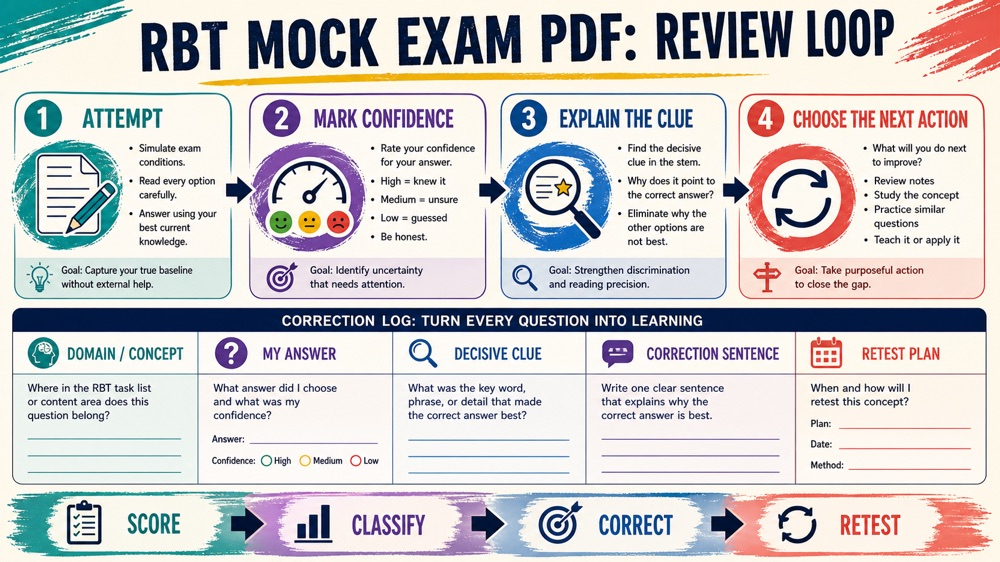
The best PDF is not necessarily the longest. A concise 85-item practice set with careful rationales can be more useful than a 200-page document that has no explanations or edition control. The file should serve a repeatable review loop: attempt, classify, explain, correct, and retest.
Also separate an exam simulator from a study guide. A simulator should protect the answer key until submission or until you intentionally switch to review mode. A study guide can reveal definitions and examples immediately. Mixing the two modes makes a score difficult to interpret.
Check the edition and question count
The current RBT TCO is the RBT Test Content Outline, 3rd edition. The outline describes 43 tasks across six domains. Current exam context includes 75 scored questions and 10 unscored pilot questions. That distinction is essential when you read claims about an “85-question” resource: 85 administered items is not the same as 85 scored items.
A practice provider may choose a different item count for a short quiz, a domain drill, or a full simulation. That is acceptable when the page says what the resource is. The problem is a PDF that labels every question as scored, calls independent practice “official,” or uses a prior edition without a visible update note.
| Claim on a PDF page | Safer interpretation | Red flag |
|---|---|---|
| “85 practice questions” | Likely a practice set matching the total administered-item count used in current exam context. | It says all 85 determine the score or calls them official exam items. |
| “75 questions plus 10 bonus” | Could be an independent 85-item practice format. | It presents the 10 as real leaked pilot items or uses old-edition language without disclosure. |
| “3rd edition aligned” | A claim that should be supported by a task/domain map and current official source. | No source, no date, or a task list from an older edition is used. |
| “Pass guarantee” | Marketing language, not an academic result. | It promises certification or a specific score from using the PDF. |
When comparing resources, record the edition, item count, timing claim, question originality statement, answer-key location, and explanation depth. This five-minute audit prevents you from building an entire study schedule around an ambiguous download.
Audit the PDF before you study
Use this pre-study checklist before attempting any items:
- Source check: find the current BACB TCO link and confirm the resource is independent.
- Edition check: look for “RBT Test Content Outline, 3rd edition,” not a vague “latest task list.”
- Scope check: confirm the resource covers the six-domain structure rather than only one popular topic.
- Format check: verify that all answer choices, page numbers, tables, and symbols render correctly.
- Explanation check: sample several rationales before you invest in a full attempt.
- Privacy check: remove client names or protected information from any notes or screenshots you make.
- Freshness check: record the access date and any version or update date supplied by the provider.
Pay attention to the difference between a resource being based on public information and being endorsed by the BACB. A provider can write original questions from a public outline without being an official source. That independence should be stated plainly, not hidden in a footer.
A PDF should also be usable on the device where you plan to study. If the answer key is an image of tiny text, the file is not ready for serious review. If the page numbering breaks when printed, fix the workflow before starting the timer. Friction is not a useful measure of exam readiness.
Use the PDF in two modes
Use the same resource differently depending on whether you are learning or measuring readiness.
| Study mode | Exam mode |
|---|---|
| Pause after each item and explain the key distinction. | Complete the full set without checking answers. |
| Mark uncertain choices before revealing the rationale. | Use the planned time window and a clean answer sheet. |
| Look up the TCO task or source after the attempt. | Do not search definitions while the timer is running. |
| Write a correction sentence in your own words. | Record only the selected answer and confidence level. |
| Repeat similar concepts with a new scenario. | Review all wrong and low-confidence items after submission. |
Do not treat a study-mode percentage as a predictive score. Immediate feedback and repeated exposure change the conditions. A timed attempt is useful for pacing and stamina; a study-mode review is useful for learning why an answer is correct. Both are valuable, but they answer different questions.
If you use a full-length practice set, schedule a short reset before reviewing. Then revisit every wrong answer and every answer you guessed correctly. A lucky answer is not stable knowledge yet.
Review answers by decision rule
When an item is wrong, avoid writing “I forgot the definition” and moving on. Name the decision rule that would have produced the correct answer.
- Measurement: Did the scenario ask for count, rate, duration, latency, IRT, or an interval sample?
- Assessment: Was the question about what the assessment identifies, what it does not prove, or who interprets the result?
- Skill acquisition: Did the item describe a prompt, prompt fading, reinforcement, shaping, chaining, or generalization?
- Behavior reduction: Did you identify the observable behavior and follow the written plan rather than infer function?
- Documentation and ethics: Did you protect privacy, report uncertainty, and stay inside the RBT role?
For example, if you choose “duration” when the question asks how long the learner waited before responding, the correction sentence is: “Latency is the delay from the stated event to response onset; duration is how long the response continues.” If you choose an intervention because it sounds helpful without a written-plan cue, the correction is: “An RBT follows the assigned procedure and reports uncertainty instead of improvising.”
This process turns an RBT mock exam PDF into a diagnostic tool. The file is not the teacher; your error analysis creates the learning value.
Build a domain-based correction log
Use a small table or spreadsheet with one row per missed or low-confidence item. Keep the wording independent and do not copy protected question text into a public document.
| Column | What to record |
|---|---|
| Item number | Local reference only, not a copied question. |
| Domain or concept | For example, measurement, assessment, prompting, ethics, or documentation. |
| My answer | The choice selected and confidence: sure, unsure, or guess. |
| Decisive clue | The word, unit, timeline, or role boundary that controls the answer. |
| Correction sentence | A short rule written in your own words. |
| Next action | Read a source, review a card, complete a new scenario, or ask a supervisor about work practice. |
Look for patterns across several attempts. Three missed measurement questions may be one unit-confusion problem, not three unrelated facts. Several ethics misses may indicate that you are choosing the most active-sounding answer instead of the role-safe answer. Pattern recognition is more efficient than rereading the entire PDF from page one.
Practice RBT mock exam PDF decisions
Use these original prompts to practice evaluating a resource and interpreting your own results:
- A PDF says “85 scored questions” but links only to a current outline describing 75 scored and 10 unscored pilot questions. What claim should you question?
- An item asks how long a learner waited after an instruction before beginning a response. Which measurement distinction should your correction log name?
- A rationale says “choose the intervention that seems most effective,” but the scenario gives a written plan and a supervisor route. Which role boundary is missing?
- You score 78% after checking answers immediately and 68% under a timed, no-feedback attempt. What do the two percentages measure differently?
- A scanned answer key has tiny unreadable text and several missing page numbers. Is that an academic weakness, a design weakness, or both? What should you do before using it?
- You get a question correct but cannot explain why the other choices are wrong. How should that item be classified in your review log?
Answer with the source, the decision rule, and the next action. A high-quality practice routine makes uncertainty visible instead of hiding it behind a single percentage.
Avoid these RBT mock exam PDF mistakes
- Downloading without checking the edition: confirm the current 3rd-edition source and update note.
- Calling independent practice official: keep the BACB source and the practice provider separate.
- Counting every item as scored: distinguish current exam context from a practice resource’s item count.
- Using one mode for every goal: timed simulation and immediate-feedback learning are different conditions.
- Reviewing only wrong answers: include guesses and low-confidence correct answers.
- Copying question text into public notes: write your correction rule in original language.
- Confusing a practice score with readiness: look for stable performance across fresh scenarios and domains.
Bottom line: choose an RBT mock exam PDF by its current source, independent status, readable design, original questions, explanation quality, and correction workflow. Use it first to learn the decision rules and then to measure pacing under controlled conditions.
Ready to turn a PDF into a study loop?
Use independent RBT practice questions, then log the decision rule behind every missed or uncertain answer.
Try Free RBT Practice Questions →
Frequently Asked Questions
What should an RBT mock exam PDF include?
It should include original practice questions, current-edition scope, readable answer choices, explanations, and a way to connect errors to the next study action.
Does an 85-question practice PDF have 85 scored questions?
Not necessarily. Current exam context distinguishes 75 scored questions from 10 unscored pilot questions. A practice resource may use 85 items, but it should not call all of them official scored items.
Is an RBT mock exam PDF official BACB material?
Independent practice PDFs are not official BACB exam content unless the BACB itself identifies them as such. Use the official BACB outline for scope and keep practice materials clearly independent.
Should I use a PDF with immediate explanations?
Yes for study mode, but use a separate timed attempt without immediate feedback when you want to evaluate pacing and stamina.
What if a PDF promises a passing score?
Treat that as marketing, not evidence. A practice score can guide review but cannot guarantee certification or a clinical outcome.
References
- Behavior Analyst Certification Board. RBT Test Content Outline, 3rd edition.
- Behavior Analyst Certification Board. RBT Handbook, updated June 2026.
- Behavior Analyst Certification Board. RBT Ethics Code.