

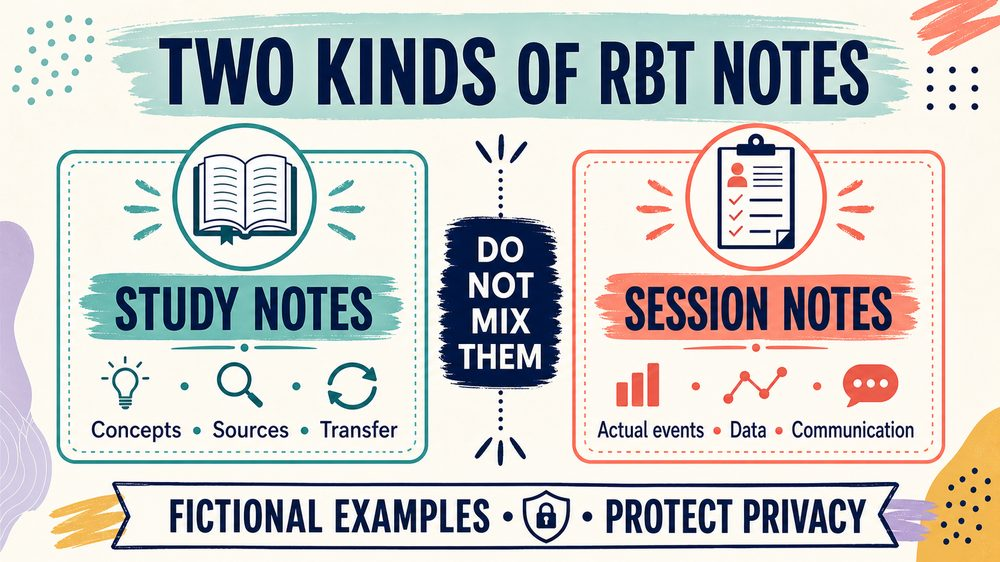
When people search for RBT notes examples, they may mean two different things: notes for studying the RBT exam, or examples of an RBT session note. Those products should not be confused. Study notes organize concepts for learning; a session note documents what actually happened in a service session under the organization’s rules and the current role requirements.
Table of Contents
- RBT notes examples: identify the kind of note first
- Study-note examples for RBT exam preparation
- A safe structure for an RBT session note
- Objective wording: turn labels into observable descriptions
- Connect notes to data and current programs
- Privacy, dignity, and workplace-specific rules
- Fictional RBT notes examples and rewrites
- A repeatable note workflow
- Frequently Asked Questions
- References
The current RBT Test Content Outline, 3rd edition, describes 43 tasks across six domains, including Documentation and Reporting and Ethics. The current exam frame includes 75 scored questions and 10 unscored pilot questions among 85 presented questions. The examples in this article are fictional, newly written, and independent. They are not official, recalled, leaked, or BACB-endorsed records or questions, and no template guarantees compliance, certification, payment, or a clinical result.
RBT notes examples: identify the kind of note first
| Note type | Purpose | What it should not become |
|---|---|---|
| Study note | Summarize a definition, decision rule, example, nonexample, and source. | A claim that your summary is the official exam or task list. |
| Session note | Record what occurred, what was implemented, learner response, data, and communication. | A copied template with invented facts or judgment labels. |
| Supervision note | Track feedback, questions, rehearsal, and next steps according to workplace practice. | A substitute for required clinical documentation. |
| Error log | Record a study mistake and the rule to practice next. | Protected client information or identifiable case details. |
If you need RBT notes examples for studying, start with the study-note format below. If you need a work note, use the organization’s form, policy, training, and supervisor direction first.
Study-note examples for RBT exam preparation
A useful study note is brief but applied. Use five fields:
- Concept: name the task or decision.
- Definition: state the concept in plain language.
- Observable clue: identify what the scenario gives you.
- Example and nonexample: show when the rule fits and when it does not.
- Source and transfer: record the current source and a new context to try.
Study-note example: latency. Definition: the time from the defined start event to the defined response. Observable clue: the scenario gives a clear instruction and a later response. Example: start timing when the instruction is delivered and stop when the target response begins, if that is the program definition. Nonexample: timing from the end of the session. Transfer: compare latency with duration in a new scenario.
Study-note example: objective documentation. Definition: describe observable events, procedures, data, and communication without unsupported labels. Observable clue: a note says “the learner was lazy.” Rewrite it with the action, context, response, consequence, and data. Source: the current TCO and Handbook. Transfer: rewrite a caregiver-request scenario.
These notes support learning; they do not replace reading the current BACB sources. Use them to generate questions for supervision or practice, not to memorize a private shortcut.
A safe structure for an RBT session note
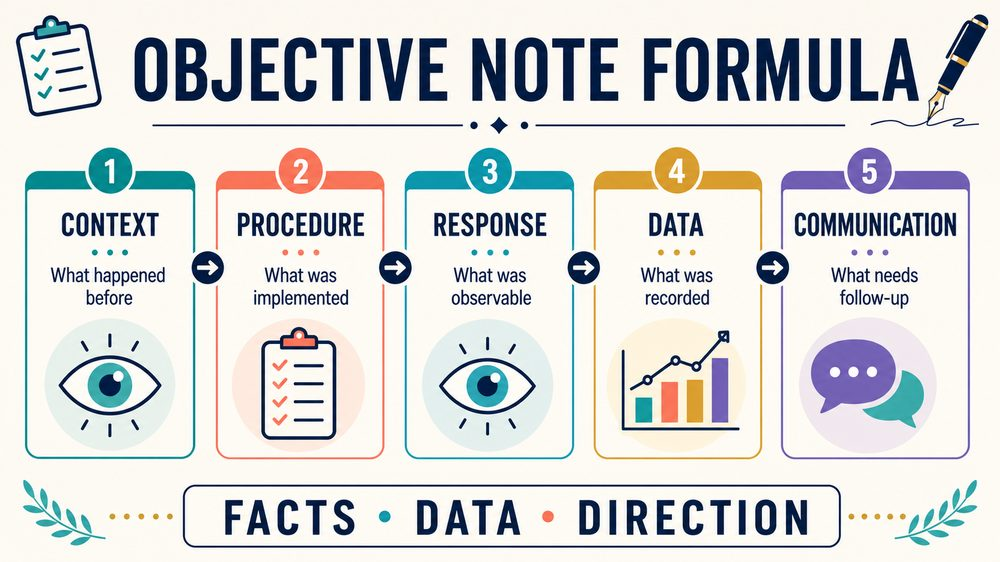
Workplace forms differ, so the organization’s required fields control. In general, an objective session note should make it possible for an authorized reader to understand:
- When and where the session occurred and who participated, using the approved system.
- Which programs or targets were addressed.
- What procedures were implemented and how the learner responded.
- Relevant data, changes, barriers, safety events, or schedule facts.
- What communication occurred with the supervisor, caregiver, or team.
- What follow-up or clinical direction is needed.
Do not fill gaps with a guess. If a required field is unknown, use the organization’s correction or escalation process. Never create a number because the note sounds more complete with one.
Objective wording: turn labels into observable descriptions
| Judgment label | Objective rewrite pattern |
|---|---|
| “The learner was defiant.” | “After the instruction, the learner pushed the materials away and used the programmed break response.” |
| “The learner was happy.” | “The learner smiled, approached the activity, and selected the offered item.” |
| “The caregiver was difficult.” | “The caregiver requested a change to the target; the request was documented and routed to the supervisor.” |
| “The program worked.” | “Across the recorded opportunities, the defined response occurred at the documented level after the programmed procedure.” |
For example: instead of writing “the learner refused all work,” describe the instruction, the observable response, the number or type of opportunities recorded, the programmed consequence, and the direction requested. The rewrite is more useful because another professional can evaluate it.
Connect notes to data and current programs
A note should not contradict the data sheet. Check that the measurement unit, target name, prompt level, independent response, and relevant consequence are described consistently with the written program. If the note says “independent” while the data records a verbal prompt, stop and correct the record through the authorized process.
- Use the program’s exact target or an approved plain-language description.
- Separate observation from interpretation.
- Describe a procedure only if it was actually implemented.
- Record missing or unusual data honestly and explain the follow-up.
- Do not convert a single session into a claim of mastery or treatment success.
Documentation is part of service quality. It also helps supervision identify whether a procedure, measurement system, or training step needs clarification.
Privacy, dignity, and workplace-specific rules
Do not use real client names, dates of birth, addresses, photographs, videos, school names, or identifying details in public examples, personal study apps, or unverified AI tools. Use fictional placeholders and keep examples generic. The approved record system and the organization’s policy control where actual documentation belongs.
Protect dignity in the language you choose. A note can be objective without being cold, and respectful without hiding a safety concern. Report observable risks and seek clinical direction; do not soften the record to make the session look successful.
Fictional RBT notes examples and rewrites
Example 1—teaching: “During a fictional session, the RBT presented the programmed instruction for requesting a break across eight opportunities. The learner used the programmed response independently on five opportunities and after the assigned prompt on three. Data were recorded in the designated fields, and the supervisor was asked to review the prompt-fading step.”
Example 2—naturalistic teaching: “During a fictional play routine, the RBT arranged the programmed communication opportunity, waited for the defined response interval, and delivered the programmed consequence after the learner used the target response. The note records the opportunity and response without claiming that the learner was motivated.”
Example 3—behavior reduction: “A fictional learner pushed materials away after an instruction. The RBT followed the written response and safety procedure, recorded the observable event, and contacted the supervisor because the plan did not specify the next step for that context.”
Example 4—caregiver communication: “The caregiver asked whether a new target could be added. The RBT acknowledged the request, documented it using the approved process, and stated that the supervisor would provide clinical direction.”
These examples show structure, not a copy-paste record. A real note must reflect the real session, required fields, actual data, and workplace policy.
A repeatable note workflow
- Prepare: review the required form, program targets, data fields, and privacy rules.
- Capture: record brief factual cues close to the event when permitted and paid by the organization.
- Verify: compare the note with the data and written procedure.
- Rewrite: remove judgment labels, unsupported motives, and invented details.
- Escalate: report errors, missing fields, safety issues, or unclear direction.
- Submit: use the authorized system and correction process.
Bottom line: good RBT notes examples make the difference between study notes and actual session documentation clear. Use fictional examples to learn objective language, use the current TCO and Handbook as sources, and let the organization’s approved form and supervisor direction govern every real record.
Practice documentation and reporting decisions.
Use original scenarios to separate observation, data, communication, privacy, and clinical direction.
Try free RBT practice questions →
Frequently Asked Questions
Are these RBT notes examples real client records?
No. They are fictional, newly written examples for study. Never copy a public example into a real record or include identifying information.
What is the difference between study notes and session notes?
Study notes summarize concepts and decision rules. Session notes document what actually occurred under the organization’s form, policy, data system, and supervision.
Can I use a template for every session?
You may use an approved workplace template, but every field must reflect the actual session. A template does not justify invented data, copied phrases, or omitted changes.
What should I do if my note and data sheet disagree?
Pause and use the authorized correction and supervisor communication process. Do not silently edit history or choose the version that sounds better.
Do RBT notes guarantee insurance or certification approval?
No. Requirements vary by organization and payer, and only the responsible organization can direct its documentation process. The current BACB sources control certification-related requirements.
References
- Behavior Analyst Certification Board. RBT Handbook.
- Behavior Analyst Certification Board. RBT Test Content Outline (3rd ed.).
- Behavior Analyst Certification Board. Ethics Codes and RBT Ethics Code (2.0).
- RBT session note template guide. Reviewed for competitor research; not an endorsement.
- RBT documentation study guide. Reviewed for competitor research; not an endorsement.