

RBT public statement examples are most useful when they show how the same fact can be stated accurately or overstated. A resume, social profile, client introduction, or service update should match the person’s current certification status, actual role, audience, evidence, and update date. This guide gives original examples for common situations while keeping the wording separate from official BACB templates, certification decisions, or individualized ethics advice.
Table of Contents
- How to use RBT public statement examples
- Examples for certification status
- Examples for role and supervision
- Examples for resumes and social profiles
- Examples for client and team communication
- Examples for service outcomes
- The five-question pre-publication check
- Frequently asked questions
- Official sources and scope
RBT public communication examples
RBT Public Statement Examples: Accurate Wording for Real Situations
Original wording examples for status, role, resumes, client communication, and service outcomes.
RBT public statement examples are most useful when they show how the same fact can be stated accurately or overstated. A resume, social profile, client introduction, or service update should match the person’s current certification status, actual role, audience, evidence, and update date.
The examples below are original educational wording, not BACB templates. Use them as prompts for checking accuracy, then compare the final statement with the current BACB guidance, the written program, and the organization’s communication process.
How to use RBT public statement examples
A public statement is any message that another person could use to understand who you are, what credential you hold, what services you provide, or what results you claim. It can be a formal advertisement, a short social-media bio, an email signature, a staff directory entry, a resume, a classroom introduction, or a sentence in a session update.
Read each example in two parts:
- Fact: what is actually true about status, role, training, supervision, or an observed event?
- Impression: what would a reasonable reader think the sentence means?
A sentence can be technically familiar but still create the wrong impression. For example, “RBT-trained” may sound like an active credential to a family that does not know the certification pathway. When a simpler, more precise sentence is available, use it.
Examples for certification status
The current status comes first. Check the BACB Certificant Registry or the appropriate account information before using a credential title. Then choose wording that does not turn a training milestone into an awarded certification.
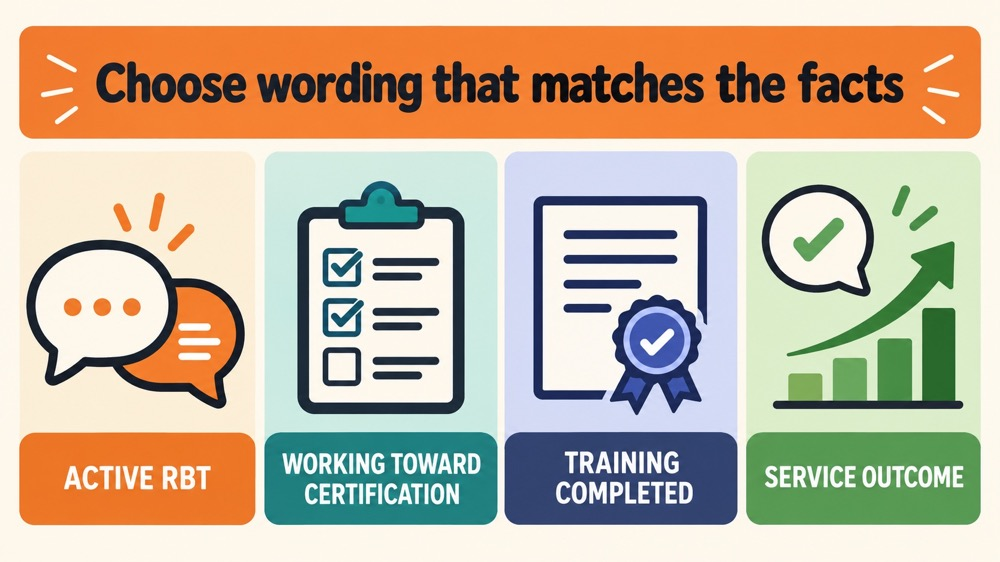
Active certification
Situation: The person’s RBT certification is active and the person is providing assigned services under the required supervision.
Clear example: “I am an RBT providing behavior-analytic services under the direction and close supervision of the responsible professional.”
Why it works: It identifies the credential and keeps the supervision and role boundary visible. It does not claim independent clinical authority or a guaranteed outcome.
Working toward certification
Situation: The person is completing steps toward certification but does not hold an active RBT certification.
Clear example: “I am completing the steps toward RBT certification.”
Avoid: “I am an RBT candidate” when the phrase would make a client or employer believe the credential has already been awarded. Follow the current BACB wording guidance for the specific setting.
Training completed
Situation: The person completed a 40-hour RBT training course but is not an active RBT.
Clear example: “I completed a 40-hour RBT training course; I am not representing that course completion as active certification.”
Why it works: It names the actual education milestone and removes the implication that training alone created a credential.
Examples for role and supervision
Credential accuracy is only one part of a public statement. The sentence should also describe the work in a way that does not imply independent diagnosis, treatment design, or unsupervised practice.
Staff directory: “Registered Behavior Technician supporting assigned behavior-analytic services under supervision.”
Introduction to a caregiver: “I am the RBT assigned to implement the current program and collect the scheduled data. I will bring clinical questions to the supervising professional.”
Training event: “I support implementation and can describe what I observed during service; the supervising professional handles program design and clinical decisions.”
When asked for a diagnosis: “I can share the observable information I recorded and connect you with the responsible professional for assessment or treatment questions.”
These examples keep the RBT role active and useful without making it independent. Adapt the language to the person’s actual assignment, demonstrated competence, and supervision structure.
Examples for resumes and social profiles
Resumes and profiles often remain online after a status or job change. Write the date, credential, and role carefully, then review older versions.
- Active resume entry: “Registered Behavior Technician (RBT), active certification; implements assigned programs, collects data, documents sessions, and participates in supervision.”
- Training entry before certification: “Completed a 40-hour RBT training course in [month/year]. Certification status: not represented as active.”
- Professional bio: “Behavior-technician professional supporting behavior-analytic services under supervision.”
- Social profile: “RBT supporting assigned services under supervision” only when the certification is active and the role description is accurate.
- Old profile correction: “Updated [date]: my previous profile wording overstated my certification status. The accurate description is [current, verified wording].”
Do not add a BACB logo, certification badge, or “official” language that suggests an endorsement when none exists. Do not describe an employer’s internal title as if it were a separate BACB credential.
Examples for client and team communication
Client-facing messages should be especially concrete because families, schools, and service partners may rely on them when deciding who is responsible for care.
Session update: “During today’s session, the learner completed four of five programmed opportunities. I recorded the data using the current measurement procedure and will review the pattern with the supervisor.”
Unexpected event: “The scheduled activity changed because the room was unavailable. I documented the change and the opportunities that were completed; the supervisor can advise whether the program needs review.”
Question outside the RBT role: “I do not want to guess about that clinical decision. I will pass the question to the supervising professional and report what I observed.”
Team handoff: “I implemented the assigned steps through the last completed opportunity, recorded the response, and noted the barrier in the session documentation. Please confirm the next direction with the supervisor.”
These sentences separate observation, implementation, and interpretation. They also avoid promising that one session proves a permanent change.
Examples for service outcomes
Service-outcome statements can mislead when they turn one observation into a guarantee. Prefer a defined event, a source of data, and a clear limit.
- Evidence-based: “Across the recorded opportunities this week, the programmed response occurred more often than in the previous review period; the supervisor will interpret the trend.”
- Too broad: “Our RBT services solved the learner’s behavior.”
- More accurate: “The learner used the programmed response during the observed opportunities; additional data and team review are needed before drawing a broader conclusion.”
- Evidence-based testimonial: “The caregiver reported that the new communication routine was easier to use at home; the team is checking how the routine generalizes across settings.”
- Too broad: “This method works for every child.”
The goal is not to make every sentence sound uncertain. The goal is to match confidence to evidence and role. A clear observation can be stated confidently without becoming a clinical promise.
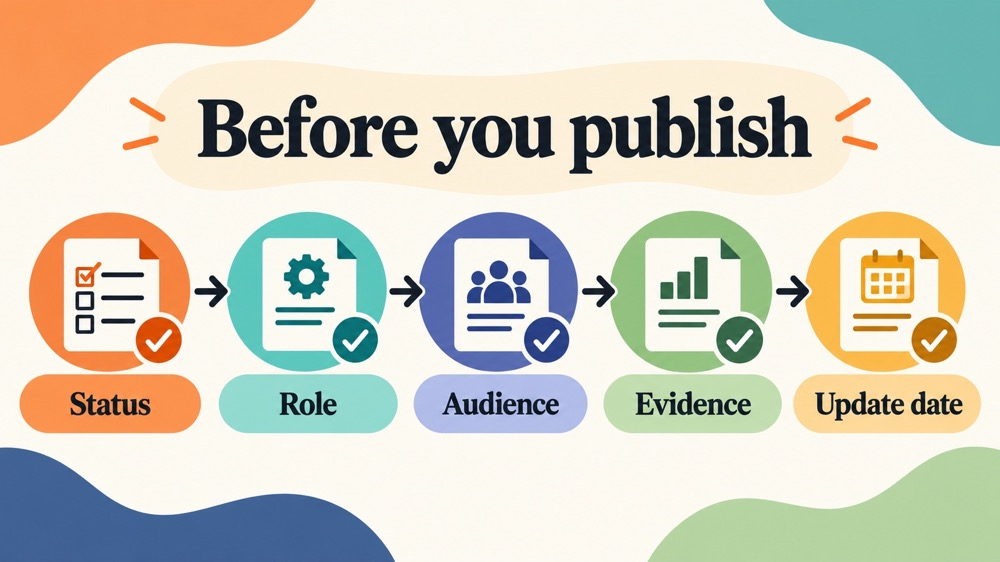
The five-question pre-publication check
Before publishing a profile, sending a bio, or sharing a service statement, ask:
- Status: Is the certification or training status current and verified?
- Role: Does the sentence describe assigned work and supervision without implying independent authority?
- Audience: Could a client, employer, school, or payer read more into the statement than the facts support?
- Evidence: Is the outcome tied to an observable event or documented data rather than a guarantee?
- Update date: Will the wording remain accurate after a certification, employer, role, or supervision change?
Frequently asked questions
Are these official BACB public statement templates?
No. They are original educational examples designed to show accurate reasoning. Use current BACB guidance and the relevant workplace process for final wording.
Can a person say they completed RBT training?
A person may accurately describe a completed training milestone, but training should not be presented as an active RBT certification. Include the actual status when the audience could be confused.
What makes a public statement misleading?
A statement can mislead when it implies an active credential, independent authority, BACB endorsement, or guaranteed outcome that the facts do not support. Context and audience matter.
Where can I check certification status?
BACB identifies the Certificant Registry as the primary resource for quickly verifying certification status. Check the live record rather than relying on an old profile or badge.
Official sources and scope
This guide was checked against the RBT Test Content Outline 3rd edition, BACB’s certification-status guidance, the Certificant Registry verification page, and the RBT ethics resources. These are examples, not official scripts or individualized decisions; use the live BACB sources for current requirements.
Ready to practice the RBT concepts you just reviewed?
Try an independent, original RBT practice resource with exam-style questions, scoring, and answer explanations.
References
- Behavior Analyst Certification Board. RBT Test Content Outline, 3rd edition.
- Behavior Analyst Certification Board. RBT Handbook.
- Behavior Analyst Certification Board. RBT Ethics Code.