

RBT session note examples are useful when they show what happened in observable language, connect the note to the written program, and make the data or barrier easy for the supervising team to review. A session note is not a place to diagnose, write a new treatment plan, speculate about motivation, or promise an outcome.
Table of Contents
- RBT session note examples: the short answer
- The structure of an objective session note
- Example: skill-acquisition session
- Example: behavior-reduction session
- Example: session change or barrier
- Privacy and recordkeeping boundaries
- Final review checklist
- Common session-note mistakes
- Frequently asked questions
- Official sources and scope
RBT documentation, objective writing, and privacy
RBT Session Note Examples: What to Record and How to Write It
Use original examples to separate observable events, data, responses, and next steps from unsupported interpretation.
RBT session note examples are useful when they show what happened in observable language, connect the note to the written program, and make the data or barrier easy for the supervising team to review. A session note is not a place to diagnose, write a new treatment plan, speculate about motivation, or promise an outcome. The RBT documents assigned services, objective observations, relevant data, communication, and follow-up under supervision.
The examples below are original educational examples, not BACB forms or records for a real client. Your employer, payer, supervisor, written program, privacy policy, and current BACB requirements may require additional fields. Use the approved system and never paste identifying information into a public template.
RBT session note examples: the short answer
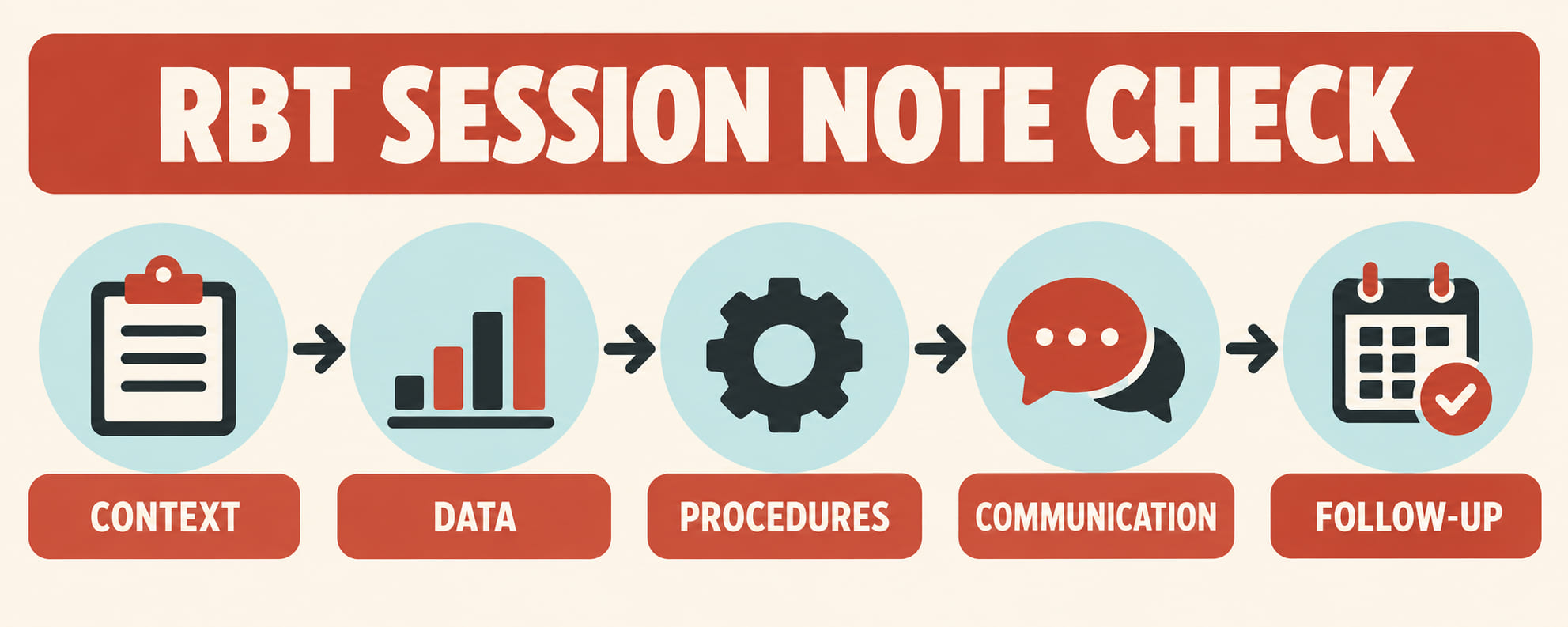
A strong RBT session note usually answers five questions:
- When and where? Record the session date, setting, service period, and required participants using the approved fields.
- What was implemented? Name the assigned skill-acquisition or behavior-reduction procedures without rewriting the entire treatment plan.
- What did the learner do? Describe observable responses, prompts, opportunities, and relevant events.
- What do the data show? Enter the required measures accurately and identify missing or unusual data.
- What was communicated? Record barriers, caregiver or team communication, safety concerns, and the direction requested from the supervisor.
The note should allow another authorized member of the team to understand the service without guessing what a vague phrase means. “Had a bad day” is not enough. “During the transition from table work to the bathroom routine, the learner dropped to the floor for approximately 45 seconds; the RBT followed the written transition procedure and notified the supervisor” gives a clearer record without adding a diagnosis.
The structure of an objective session note
Before writing an example, separate the note into evidence layers:
| Layer | Include | Avoid |
|---|---|---|
| Context | Date, setting, service period, authorized participants, and relevant schedule change. | Unnecessary personal details or identifying information in an unapproved place. |
| Implementation | Assigned program, materials, prompt level, reinforcement arrangement, and procedure followed. | Claiming to have designed or changed a procedure independently. |
| Observation | Observable response, duration, count, latency, opportunity, or other required measure. | Labels such as lazy, manipulative, unmotivated, or noncompliant without operational evidence. |
| Communication | What was reported, to whom, when, and what direction was requested or received. | Confidential details sent through an unauthorized channel. |
Example: skill-acquisition session
Scenario: The written program targets requesting a break using the learner’s approved communication response. The RBT is trained to use the prompt and reinforcement sequence described by the supervisor.
Objective note example: “The session occurred in the classroom during the scheduled service period. The RBT implemented the approved break-request program across 10 opportunities. The learner independently used the programmed break response on 6 opportunities, used a model prompt on 3 opportunities, and did not respond on 1 opportunity. A two-minute break was delivered according to the written procedure after the programmed response. The learner returned to the activity after 8 of 9 breaks. One transition required an additional prompt; the RBT recorded the event and will review the pattern with the supervisor.”
This example names the target response, opportunities, prompt information, reinforcement relation, and a follow-up question. It does not say the learner was “happy,” “understood the lesson,” or “mastered communication” unless the program’s defined criteria and data support those statements.
Example: behavior-reduction session
Scenario: The RBT implements an approved response plan for a behavior defined by the supervising team. The note must use the operational definition and required measurement system.
Objective note example: “During the first activity, the defined response occurred 3 times and lasted 20 seconds, 35 seconds, and 15 seconds. The RBT followed the written safety and response procedure, used the trained prompt, and recorded each episode on the approved data sheet. No injury occurred. The learner rejoined the activity after the third episode with the programmed support. The RBT notified the supervisor about a possible pattern during the transition and did not change the intervention or measurement rule.”
The note reports the defined measure and the procedure followed. It does not claim why the behavior happened, announce a functional assessment result, or recommend a new consequence. Those decisions belong to the responsible professional and the written plan.
Example: session change or barrier
Changes in staffing, setting, materials, health, transportation, or schedule can affect a session. Document the relevant event without exposing unnecessary medical or family information.
Objective note example: “The session began 15 minutes later than scheduled because the classroom was moved to a different room. The RBT confirmed the change with the designated contact, checked that the approved materials were available, and followed the supervisor’s direction to begin with the familiar matching program. The learner completed 8 of 10 opportunities with the programmed prompt level. The planned group activity was not run because the approved materials were unavailable; the RBT recorded the barrier and notified the supervisor. No unapproved program change was made.”
This style preserves the sequence: what changed, what the RBT checked, what was implemented, what could not be completed, and who was notified. It avoids turning a schedule problem into a judgment about the learner or the family.
Privacy and recordkeeping boundaries
Session notes are protected records in many settings. Use the employer’s approved record system, follow access controls, and share information only with authorized people for an authorized purpose. BACB ethics and local privacy rules do not turn a public article template into an acceptable storage location.
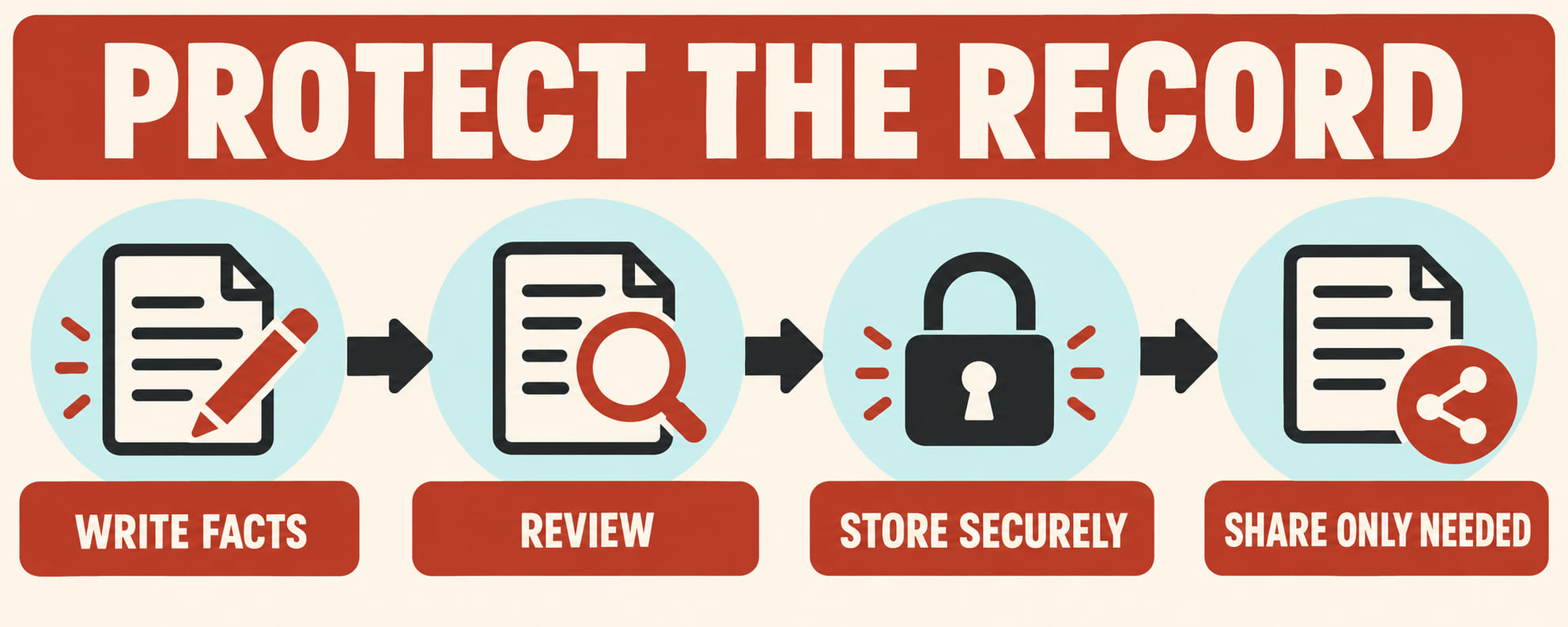
Do not include a client’s full name, address, school, medical details, or identifying photographs in a public example. If a note needs correction, follow the organization’s correction policy rather than deleting history or quietly changing a signed record. Keep the original information when the system requires an audit trail.
Final review checklist
- The date, service period, setting, and required participants are complete.
- The note identifies the assigned program or procedure without claiming independent treatment design.
- Observable responses and the required measurement are recorded accurately.
- Prompting, reinforcement, materials, and deviations match the written program.
- Barriers, safety events, caregiver communication, and supervisor communication are documented when relevant.
- Subjective labels and unsupported causal conclusions are removed.
- Privacy, access, correction, and retention rules are followed.
- The note is complete enough for an authorized reviewer to understand what happened.
Common session-note mistakes
- Writing a story instead of a record. Keep the note tied to observable events and required measures.
- Using judgment words. Replace “unmotivated” with the observable response and the defined data.
- Inventing a function. Report what occurred; do not turn one note into an assessment conclusion.
- Claiming a program change. Document a deviation and notify the supervisor instead of independently changing criteria.
- Copying the previous note. Confirm that each date, measure, prompt, barrier, and communication detail is current.
- Sharing too much. Use the minimum necessary information in the authorized system.
Frequently asked questions
Can I copy these RBT session note examples into a client record?
No. They are original educational examples. Use your organization’s approved format, the learner’s written program, and the supervisor’s direction for a real record.
Should an RBT include opinions in a session note?
Use objective observations and the required data. If you have a clinical concern, document the observable event and report it through supervision rather than presenting an unsupported interpretation as fact.
Can an RBT change the treatment plan in a note?
No. An RBT should record what was assigned, what occurred, and what was reported. Changes requiring clinical authority should come through the responsible professional and the written plan.
What if a session barrier prevents the planned program?
Record the relevant barrier, what approved alternative or safety step was used, the data that were available, and who was notified. Do not hide a missed procedure or invent data.
Are session notes private?
They should be handled as protected service records under the applicable organization, payer, legal, and privacy rules. Use the approved system and authorized access route.
Official sources and scope
Review the current BACB RBT Handbook, the RBT Test Content Outline, the BACB ethics resources, and your organization’s documentation and privacy policies. These examples are educational content, not official BACB forms, legal advice, medical advice, or individualized supervision direction.
Ready to practice the RBT concepts you just reviewed?
Try an independent, original RBT practice resource with exam-style questions, scoring, and answer explanations.
References
- Behavior Analyst Certification Board. RBT Test Content Outline, 3rd edition.
- Behavior Analyst Certification Board. RBT Handbook.
- Behavior Analyst Certification Board. RBT Ethics Code.