
If you search for the RBT task list 3rd edition, you may see two names used for the same exam-preparation conversation. The official current document is the RBT Test Content Outline (3rd ed.), or TCO. “RBT task list 3rd edition” is a common search phrase because the earlier official document was called the RBT Task List. Use the search phrase to find the topic, then verify the document title and edition before you study.
Table of Contents
- RBT task list 3rd edition: what the official document is called
- RBT task list 3rd edition: 2nd-edition differences to check first
- The six domains in the current RBT TCO
- How to use the 43 task codes without memorizing a flat list
- How to study from the current RBT task list 3rd edition
- Common version and wording traps
- Original RBT task list 3rd edition scenarios
- Frequently Asked Questions
- References
The practical question is not whether a guide says “3rd edition” on its cover. It is whether the guide matches the current BACB blueprint: 43 tasks organized into six domains, with the current exam frame of 75 scored questions and 10 unscored pilot questions among 85 presented questions. The exam has four answer choices per question and a 90-minute limit. This article is independent study content, not an official BACB guide, recalled item, leaked item, endorsed question set, or pass guarantee.
RBT task list 3rd edition: what the official document is called
The current BACB document is titled RBT Test Content Outline (3rd ed.). It describes the content that appears on the RBT certification examination beginning in 2026 and represents the knowledge, skills, and abilities identified for entry-level behavior technicians through the job-task-analysis process. The phrase “task list” remains useful for search and conversation, but a careful study workflow should call the source what it is: the current RBT TCO.
This distinction matters because a page can use familiar wording while quietly linking an older PDF. Check the cover, the edition, the update date, the task-code format, the six domain names, and the official BACB URL. A current guide may explain concepts in plain language, but it should not replace the source blueprint.
RBT task list 3rd edition: 2nd-edition differences to check first
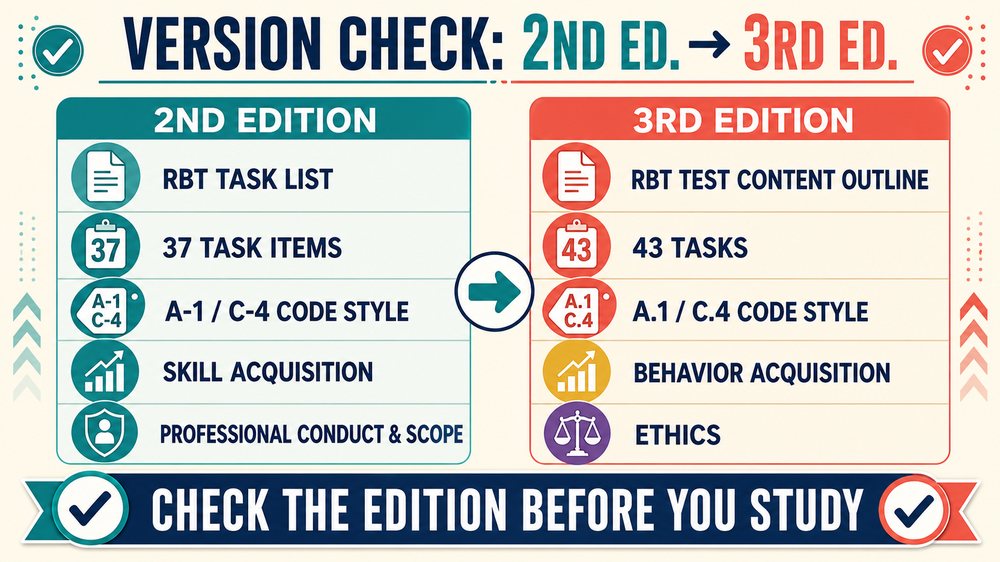
The 2nd-edition document is an official older source, but it should not be treated as the current 2026 exam blueprint. The 2nd edition lists 37 task items across six content areas. The 3rd-edition TCO lists 43 tasks across six domains. The count is not the only change: several labels, task codes, and task emphases are different.
| Version check | 2nd edition | 3rd edition TCO |
|---|---|---|
| Official document name | RBT Task List | RBT Test Content Outline |
| Task count | 37 listed items | 43 tasks |
| Code style | A-1, C-4, F-5 | A.1, C.4, F.10 |
| Acquisition label | Skill Acquisition | Behavior Acquisition |
| Professional domain | Professional Conduct and Scope of Practice | Ethics |
| Exam blueprint | Older training/exam basis | Current exam basis beginning in 2026 |
For example, a study sheet that says “C-8 stimulus control transfer” and ends at “F-5 maintain client dignity” is showing the older code system. That does not make every concept useless, but it is a signal to cross-check the material against the current TCO. Do not assume that a page is current because its publication date is recent; the linked source and task labels are stronger evidence.
The six domains in the current RBT TCO
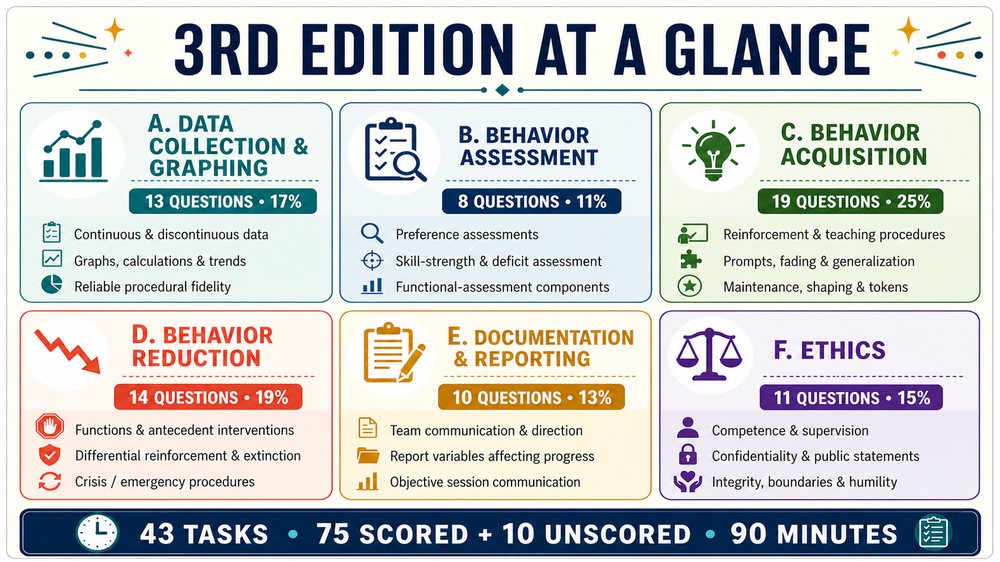
The current RBT task list 3rd edition search topic resolves to six official domains. The question percentages below are rounded values published with the TCO. They are a study-prioritization signal, not separate pass thresholds; the Handbook states that the examination result is based on overall performance.
| Domain | Tasks | Scored-question share | What to recognize |
|---|---|---|---|
| A. Data Collection and Graphing | 8 | 13 questions / 17% | Measurement, data entry, graphs, calculations, trends, reliability, fidelity. |
| B. Behavior Assessment | 3 | 8 questions / 11% | Preference, skill-strength/deficit, and functional-assessment participation. |
| C. Behavior Acquisition | 11 | 19 questions / 25% | Reinforcement, teaching, prompts, chaining, discrimination, generalization, shaping, tokens. |
| D. Behavior Reduction | 7 | 14 questions / 19% | Functions, antecedent interventions, differential reinforcement, extinction, punishment, crisis procedures. |
| E. Documentation and Reporting | 4 | 10 questions / 13% | Communication, clinical direction, variables affecting progress, objective reporting. |
| F. Ethics | 10 | 11 questions / 15% | Competence, supervision, confidentiality, public statements, relationships, gifts, cultural humility. |
The percentages add to 100% after rounding. The domain with the largest share is Behavior Acquisition, but candidates should not ignore Ethics or Documentation and Reporting because scenario questions can combine decisions across domains.
How to use the 43 task codes without memorizing a flat list
Read each code as a behavior a technician should be able to perform or recognize. The first letter names the domain, and the number identifies the task within that domain. A strong note has three parts: the task wording, the observable decision, and a short original example.
- A.1–A.8: connect the measurement method to what can be observed, recorded, summarized, and graphed.
- B.1–B.3: distinguish preference assessment, skill assessment, and participation in functional-assessment components.
- C.1–C.11: study implementation details, especially prompt fading, generalization, maintenance, shaping, and token economies.
- D.1–D.7: separate function identification from implementation of an authorized behavior-reduction procedure.
- E.1–E.4: practice timely escalation, objective communication, and reporting variables that may affect progress.
- F.1–F.10: treat ethics as applied conduct, not a vocabulary-only section.
When a task says “implement,” ask what the technician does in the written procedure. When it says “identify,” ask what clue the scenario provides. When it says “describe,” ask whether the answer needs a definition, risk, or consequence. This turns a list into decision practice.
How to study from the current RBT task list 3rd edition
- Lock the source: download the BACB 3rd-edition TCO and current Handbook; record the title and update date in your notes.
- Map the domains: make six sections labeled A through F and place every task under its domain.
- Translate the verb: mark each task as implement, identify, describe, calculate, communicate, or comply.
- Build one decision example: write an original situation that shows the task without copying a real exam item.
- Practice contrasts: compare pairs such as continuous versus discontinuous measurement, preference versus skill assessment, acquisition versus maintenance, and objective report versus interpretation.
- Review errors by task code: do not write only “missed data question.” Write “missed A.2 because I confused whole-interval recording with partial-interval recording.”
- Recheck version: before using a study guide, verify that its labels, codes, counts, and exam facts match the current TCO and Handbook.
Use the domain weights to plan time, but use errors to decide what to revisit. A candidate who gets every definition right but chooses an unsafe or unauthorized action in a scenario still needs applied practice. The current RBT task list 3rd edition is best used as a control map for questions, notes, and explanations—not as a promise that memorizing headings will be enough.
Common version and wording traps
| What you see | Why it may be a problem | Better check |
|---|---|---|
| “Four domains in the 3rd edition” | It conflicts with the official six-domain TCO. | Compare the page with the BACB PDF. |
| “The task list has exactly 42 items” | Some summaries count or describe items imprecisely. | Use the official count of 43 tasks. |
| Only A-1 / B-2 style codes | Likely older task-list formatting. | Look for A.1 / B.2 current TCO codes. |
| “Buy this guide and pass” | Preparation materials cannot guarantee certification. | Choose source-aligned explanations and measure your own readiness. |
| “Official practice questions” | Commercial or independent questions are not automatically BACB content. | Require original items and clear non-endorsement language. |
Original RBT task list 3rd edition scenarios
Scenario 1—measurement: a question says the behavior was recorded only when it occurred during the entire interval. The key distinction is whole-interval discontinuous measurement, not frequency. Identify the method before calculating a percentage.
Scenario 2—assessment: a technician presents several items to learn which the learner selects most often. That points toward a preference-assessment procedure. It does not authorize the technician to diagnose a function or redesign a skill program.
Scenario 3—documentation: a learner arrives after a medication change and performance is different. The RBT should document the relevant variable objectively and communicate it through the supervision structure, rather than explain the cause as a fact.
Scenario 4—ethics: a caregiver asks the RBT to send client details through a personal social-media account. The response should protect confidentiality, follow workplace policy, and seek direction—not treat convenience as permission.
These are newly written independent study examples. They are not official, recalled, leaked, or BACB-endorsed questions.
Bottom line: use “RBT task list 3rd edition” to find the topic, but use the official RBT Test Content Outline (3rd ed.) to control your study map. Confirm 43 tasks, six domains, current code formatting, official exam facts, and the difference between an educational summary and the BACB source. Then practice the observable decision each task requires.
Study from the current blueprint.
Review original RBT scenarios by domain and use each explanation to identify the next task code to revisit.
Review RBT study materials →
Frequently Asked Questions
Is the RBT Task List 3rd Edition the official name?
The current BACB document is titled the RBT Test Content Outline (3rd ed.). Task list is common shorthand because the earlier official document used that title.
How many tasks are in the current RBT TCO?
The current TCO includes 43 tasks organized into six domains.
Can I use a 2nd-edition study guide?
Use caution. It may explain foundational concepts, but you should cross-check every domain label, task code, count, and exam-format claim against the current 3rd-edition TCO and Handbook.
How many questions are on the current RBT exam?
The current exam frame includes 75 scored questions and 10 unscored pilot questions among 85 presented questions, with four answer choices and a 90-minute limit.
Are the scenarios in this article official exam questions?
No. They are newly written independent study examples and are not official, recalled, leaked, or BACB-endorsed questions.
References
- Behavior Analyst Certification Board. RBT Test Content Outline (3rd ed.).
- Behavior Analyst Certification Board. RBT Handbook.
- Behavior Analyst Certification Board. RBT Task List (2nd ed.). Used for the version comparison.
- Current-edition study guide page. Reviewed for competitor research; not an endorsement.
- RBT Task List 3.0 guide. Reviewed for competitor research; not an endorsement.