
An RBT task list study guide PDF can make revision easier to print, annotate, and revisit. It can also create a problem if the file is based on the wrong edition, compresses the tasks into vague slogans, or presents independent explanations as official BACB content. The file format is useful only when the academic source is controlled.
Table of Contents
- What an RBT task list study guide PDF should contain
- Verify the current edition before printing
- Turn each task into a study card
- Use printable and digital modes
- Check academic and ethical boundaries
- Build a task-list correction log
- Practice PDF decisions
- Avoid these task-list PDF mistakes
- Frequently Asked Questions
- References
This guide shows how to audit an RBT task-list PDF, use the current RBT Test Content Outline, 3rd edition, and turn each task into a definition, a distinction, and a fresh application. It also explains when a printable file is better than a screen-based quiz and how to keep the study resource independent.
RBT Training is independent and is not affiliated with, operated by, or endorsed by the Behavior Analyst Certification Board (BACB). The examples and practice prompts below are newly written for independent study. They are not official, recalled, leaked, or BACB-endorsed questions. No PDF or study plan guarantees a passing result.
What an RBT task list study guide PDF should contain
A strong PDF is a navigation tool, not just a vocabulary dump. It should let you locate the current task, read a concise explanation, compare a nearby concept, and practice the decision in a new context.
| PDF component | Quality question | Why it matters |
|---|---|---|
| Edition label | Does the file name the RBT TCO, 3rd edition, and its source? | Prevents a printable file from quietly preserving old scope. |
| Task map | Are all 43 current tasks represented across A–F? | Helps you identify coverage instead of relying on page count. |
| Definitions | Are terms stated in observable, usable language? | Supports discrimination between close concepts. |
| Examples | Are examples newly written and clearly independent? | Protects attribution and avoids recalled-item claims. |
| Practice checks | Do prompts ask you to apply a rule? | Moves study beyond recognition. |
| Revision fields | Can you write the clue, error, and next action? | Turns a PDF into a feedback loop. |
Page count is not a quality metric by itself. A short task map with accurate distinctions can be more useful than a long file with repeated paragraphs. Check whether the PDF makes its limits visible: independent study aid, not official exam content; source-aligned, not endorsed; helpful for preparation, not a guarantee.
Verify the current edition before printing
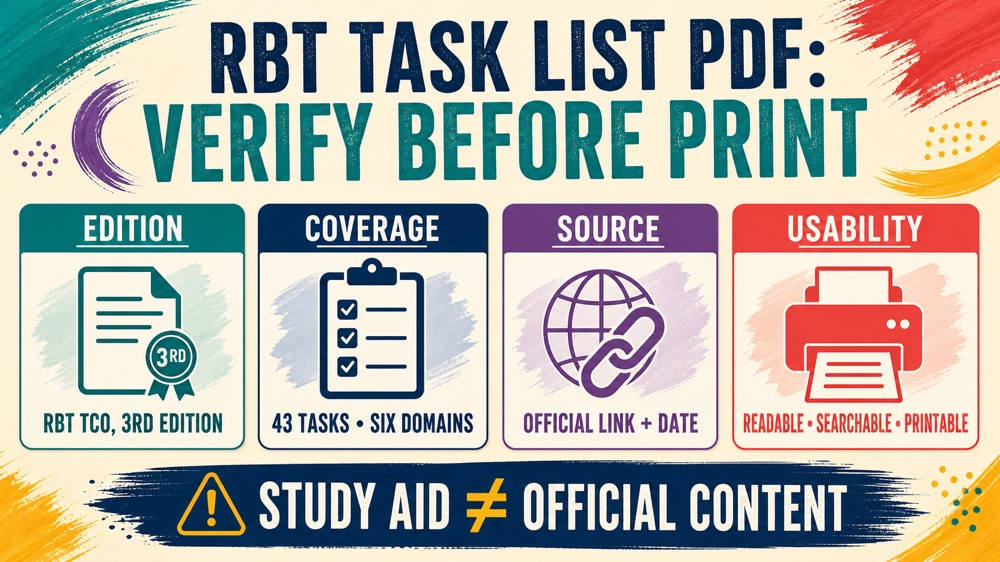
The current academic source is the RBT Test Content Outline, 3rd edition. It describes 43 tasks across six domains. Current exam context includes 75 scored questions and 10 unscored pilot questions. A study guide may summarize, teach, or reorganize the tasks, but it should not replace the official source.
| Verification step | What to record |
|---|---|
| Open the official TCO | Source URL, edition name, and access date. |
| Compare task count | 43 current tasks, grouped under A–F. |
| Compare domain names | Data Collection and Graphing, Behavior Assessment, Behavior Acquisition, Behavior Reduction, Documentation and Reporting, Ethics. |
| Mark old-language notes | Former labels may be useful as cross-references, but must not be presented as current without context. |
| Check update date | PDF version, last revision, and whether links still work. |
Search results often mix current 3rd-edition resources with 2nd-edition PDFs. A file that says “task list” is not automatically current. Put the official source at the front of your binder or notes, then use independent guides as explanations and practice.
Turn each task into a study card
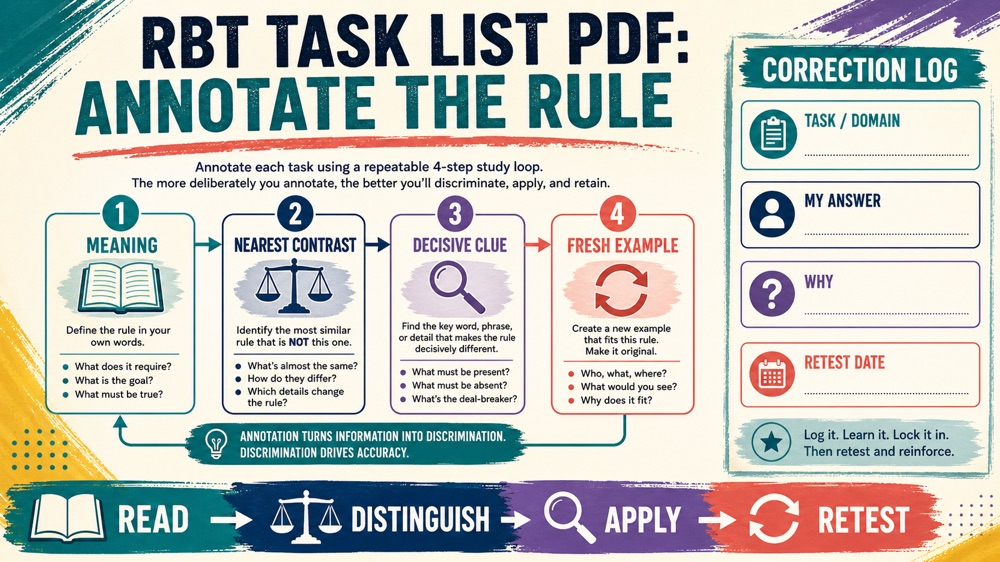
For each task, create four small fields:
- Plain-language meaning: what would you observe or implement?
- Nearest contrast: which concept is easiest to confuse with it?
- Controlling clue: what word, unit, timeline, or plan condition decides?
- Fresh example: can you apply the rule to a new situation without copying a source?
For measurement, a card might contrast latency and duration. For assessment, it might separate a preference ranking from a claim that a stimulus functions as reinforcement. For skill acquisition, it might compare prompting with reinforcement. For documentation and ethics, it might contrast objective reporting with a subjective label or unauthorized disclosure.
Do not write “know everything about this task.” Write what a correct decision would look like. That makes the card testable and helps you find the exact gap after a practice question.
Use printable and digital modes
Printing can support slower, deliberate review. Digital study can support search, timers, and quick cross-references. Use each for the task it handles best.
| Printable PDF | Digital resource |
|---|---|
| Annotate definitions and write contrast pairs by hand. | Search a keyword and jump between task sections. |
| Use a binder tab for each domain. | Run a timed practice set and track items. |
| Keep a visible correction log on the next page. | Review explanations after submitting an answer. |
| Useful for offline revision and spaced review. | Useful for fresh scenarios and adaptive practice. |
Before printing, check page breaks, contrast, font size, table width, and whether links or footnotes remain readable. A file that looks fine on a laptop can become unusable on paper if the answer column is cut off.
Do not let formatting become the study goal. If the PDF is beautiful but lacks task boundaries and explanations, it is a poster, not a study guide.
Check academic and ethical boundaries
Use the official TCO for scope and the current handbook and ethics code for role and professional boundaries. Independent writers should clearly label their own content as practice.
- Official source: the BACB publishes the TCO and requirements resources.
- Independent explanation: a provider explains concepts in its own words and should identify sources.
- Practice item: a newly written scenario tests understanding without copying official or recalled content.
- Workplace direction: a supervisor or responsible behavior-analytic professional handles client-specific decisions.
Do not copy a client’s name, treatment data, or identifying details into a public annotation. Use generic, original examples. If a task-list PDF asks the RBT to diagnose, select treatment independently, or guarantee an outcome, treat that as a boundary problem and return to the written plan and supervision route.
Build a task-list correction log
Keep one line per error or low-confidence answer:
| Field | Example |
|---|---|
| Task and domain | A.3 discontinuous measurement. |
| My answer | Selected whole interval. |
| Decisive clue | “At any point during the interval.” |
| Correction sentence | Any occurrence earns a positive partial-interval score. |
| Fresh application | Write a new 30-second example and solve it. |
| Retest date | Return after a delay with a different scenario. |
Use confidence labels. A correct answer that was guessed is not the same as a correct answer you can teach. Your PDF becomes a living study map when annotations point to a next action rather than only marking a page.
Practice PDF decisions
These original prompts help you audit a task-list guide and use it responsibly:
- A PDF says it covers the “RBT task list” but links only to a 2nd-edition source. What should you verify before treating it as current?
- The file has 43 checkboxes but no domain labels. What extra map would make the checklist more useful?
- A definition says a preferred stimulus is always a reinforcer. Which distinction should you add to the margin?
- A printed table cuts off the “nearest contrast” column. Does the file pass a practical design check? What should you do?
- A practice explanation tells an RBT to invent a new intervention when the plan is unclear. Which role boundary should your correction log record?
- You know a task definition but miss a fresh scenario. Which of the four study-card fields needs more work?
Answer from the source, the task, and the role boundary. The goal is not to make every PDF look the same; it is to make every study decision traceable.
Avoid these task-list PDF mistakes
- Printing before checking the edition: verify source, date, and task count first.
- Confusing a task list with a complete textbook: add explanations, contrasts, and application.
- Using page count as evidence: evaluate accuracy and usability instead.
- Copying official or third-party text: write independent examples and attribute sources.
- Leaving out old/new terminology: show the current label and explain any cross-reference.
- Ignoring print QA: check tables, page breaks, text size, and links.
- Studying without a correction log: turn each missed concept into a fresh action.
Bottom line: an RBT task list study guide PDF is useful when it is current, source-labeled, complete enough to map all 43 tasks, readable in print, and built around transferable decisions. Use the official TCO for scope and the PDF for structured independent review.
Ready to turn the task list into practice?
Use independent RBT practice questions, then annotate the exact task, clue, and next action in your study guide.
Try Free RBT Practice Questions →
Frequently Asked Questions
What should an RBT task list study guide PDF include?
It should include a current edition label, a task and domain map, clear explanations, original examples, contrast points, and space for corrections.
Is every RBT task-list PDF current?
No. Check the edition, source link, update date, and whether the file maps the current 43 tasks across six domains.
How many tasks are in the current RBT outline?
The current RBT Test Content Outline, 3rd edition, describes 43 tasks across six domains.
Can I use a PDF instead of official BACB resources?
Use independent PDFs as study aids, but return to the official TCO, handbook, and ethics code for scope and requirements.
How do I study from a long PDF?
Convert each task into a meaning, nearest contrast, controlling clue, and fresh example, then record errors in a correction log.
References
- Behavior Analyst Certification Board. RBT Test Content Outline, 3rd edition.
- Behavior Analyst Certification Board. RBT Handbook, updated June 2026.
- Behavior Analyst Certification Board. RBT Ethics Code.
- Free RBT Study Guide resource. Accessed for competitor research; not an endorsement.