
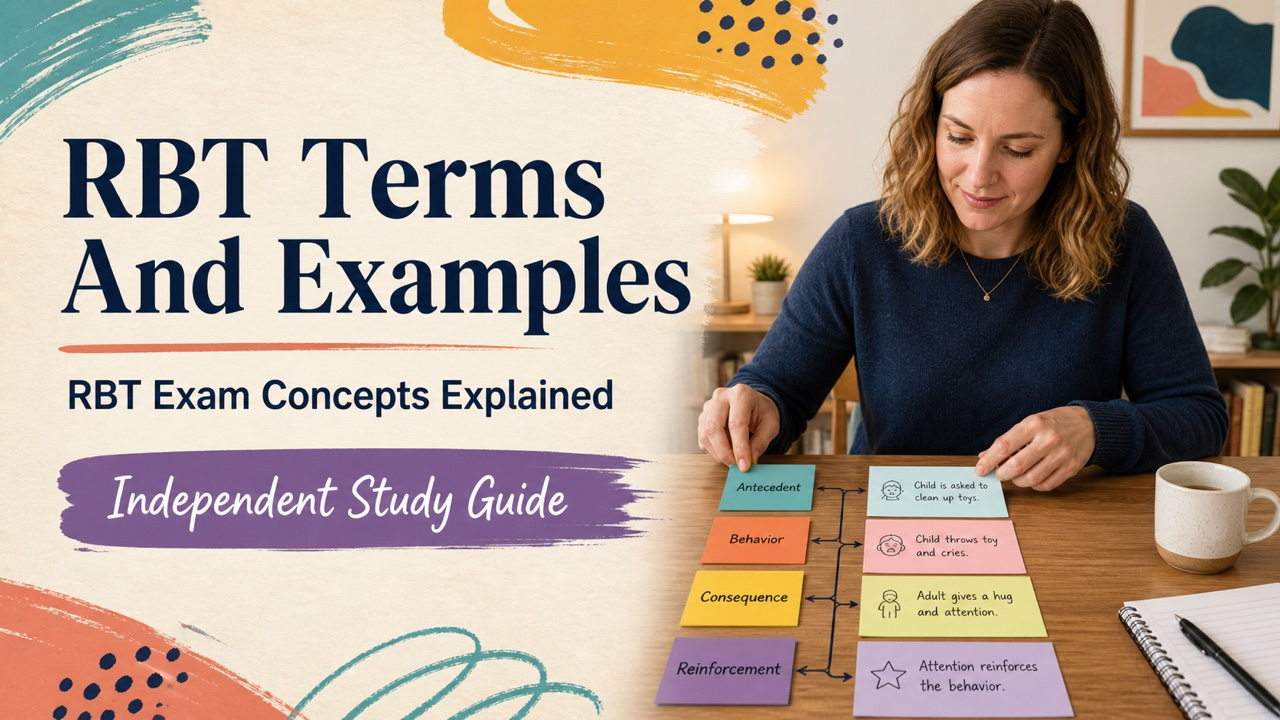
RBT terms and examples are easier to remember when the example shows a condition, observable response, consequence or teaching action, and the data rule. Build examples from current BACB sources, keep them original, and state where the written plan or supervisor controls the next step. This page is independent educational content, not an official glossary or answer key.
Table of Contents
- Build an RBT terms and examples source log
- Use a four-part example structure
- Write measurement examples
- Write acquisition examples
- Write reduction and assessment examples
- Write documentation and ethics examples
- Use RBT terms and examples for active recall
- Avoid weak examples
- RBT terms and examples checklist
- Frequently Asked Questions
- References
Continue your RBT study with RBT exam study materials and original practice resources.
Quick answer: Treat rbt terms and examples as a current-source RBT study topic. Define the concept, connect it to an observable action, use original examples, and keep the supervision boundary visible.
Study boundary: This independent guide is educational content. It is not a BACB policy, certification decision, legal opinion, answer key, or guarantee of examination success. It does not promise a passing score or certification outcome. Examples are original and are not official, recalled, leaked, or BACB-endorsed questions.
Current exam context: The current BACB RBT Test Content Outline describes 43 tasks across six domains; the examination includes 75 scored questions and 10 unscored pilot questions in a 90-minute testing period. Verify the current handbook and outline before relying on a time-sensitive detail.
Build an RBT terms and examples source log
Record the current RBT Test Content Outline, Handbook, and Ethics Code with their version dates and official URLs. Beside each term, add a plain-language meaning, an original scenario, and a role boundary. This prevents a short example from silently becoming an overly broad rule.
When the written program controls the details, write that dependency directly on the study card. A good example teaches the learner what to notice, not permission to improvise.
Use a four-part example structure
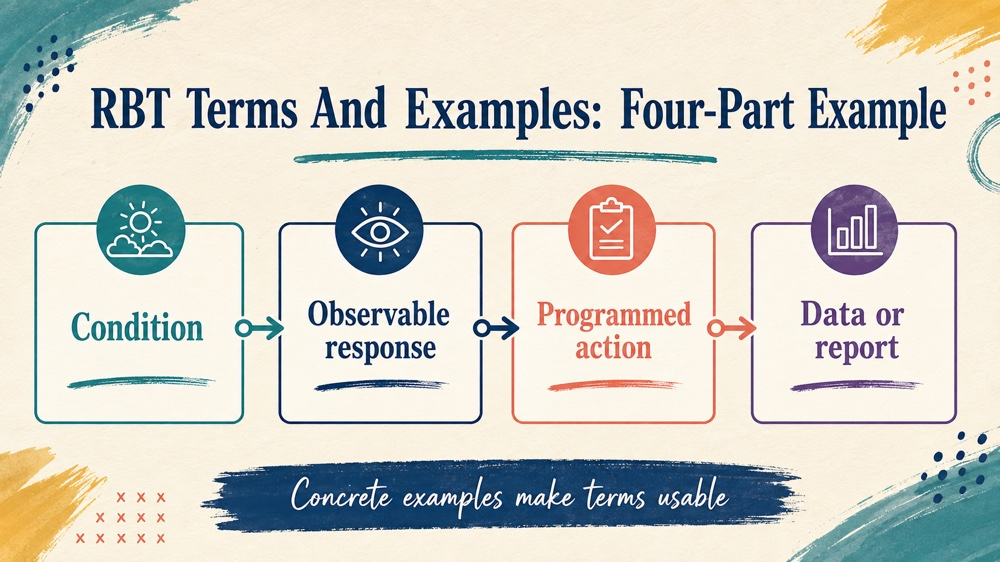
A strong RBT example names the condition, the observable response, the programmed action or consequence, and what is recorded. Add a boundary sentence when the concept involves assessment, function, treatment, safety, or a plan change. This structure keeps definitions tied to practice.
- State the setting or instruction.
- Describe what can be observed.
- Name the assigned action or data rule.
- State what is reported or checked.
- Mark the supervision boundary.
Write measurement examples
For frequency, rate, duration, latency, interval recording, permanent product, and percentage, show what is counted or timed and when scoring starts and ends. Do not use a vague sentence such as ‘record the behavior’; include the operational definition and the measure selected by the plan.
If a data sheet is missing or the rule is unclear, the example should show documenting the barrier and seeking direction. Do not invent a count to make the scenario tidy.
Write acquisition examples
For reinforcement, prompting, fading, shaping, chaining, discrimination, generalization, maintenance, and task analysis, describe the learner response and the RBT action. Include what is recorded, such as prompt level or independent responding, while leaving program-specific criteria to the written plan.
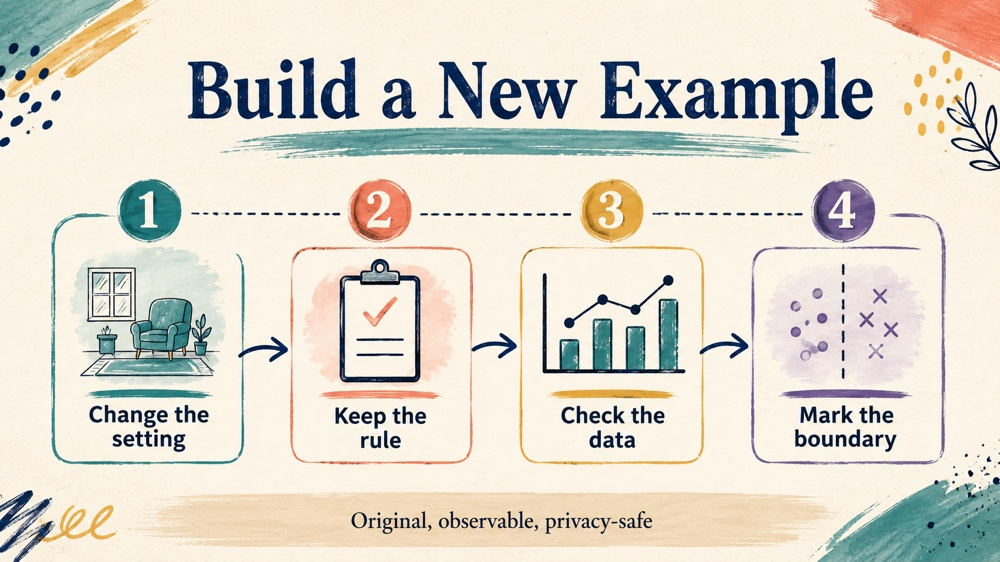
A useful example changes one variable at a time so the learner can explain why the action still fits or why a handoff is needed.
Write reduction and assessment examples
Use antecedent, consequence, differential reinforcement, extinction, safety, and assigned assessment participation carefully. The RBT may implement procedures as trained, collect data, and report observations; the example should not imply independent diagnosis or treatment redesign.
Write the handoff beside any uncertainty: who evaluates the observation, who approves the next step, and what objective information is communicated?
Write documentation and ethics examples
Show objective notes, confidentiality, competence, supervision, accurate records, and reporting through fictional scenarios. Distinguish observable fact from interpretation and disclose only what the communication route requires. An ethical example is concrete without revealing identifying details.
Check whether the example could be copied into a real note without adding unsupported assumptions. If not, revise it into observable language.
Use RBT terms and examples for active recall
Hide the term, infer it from the scenario, explain the definition, and create a new example with a changed condition. Tag a miss by vocabulary, measurement, application, documentation, ethics, or role boundary. Interleaving terms helps prevent a familiar word from triggering an automatic but inaccurate answer.
The current examination includes 75 scored questions and 10 unscored pilot questions in a 90-minute testing period. Verify current official sources before using time-sensitive details.
Avoid weak examples
- Using a definition with no observable condition.
- Confusing a consequence with a function.
- Leaving out the data or documentation rule.
- Turning a study example into independent clinical permission.
- Including identifying client details.
- Copying recalled or protected examination questions.
- Failing to state when supervision or the written plan controls the action.
RBT terms and examples checklist
- Does every term have a current source?
- Does each example include an observable condition and action?
- Are measurement start and stop rules visible?
- Are acquisition, reduction, assessment, documentation, and ethics represented?
- Is the role boundary explicit?
- Are examples original and privacy-safe?
- Can I create a new scenario after a miss?
Use RBT terms and examples as a source-linked practice system. Keep each example concrete, original, privacy-safe, and bounded by the written plan and supervision. RBT Training is independent educational content and is not affiliated with or endorsed by BACB.
Practice the concept
Review rbt terms and examples with original RBT scenarios, current-source reminders, and clear role boundaries.
Review the RBT study resource →
Frequently Asked Questions
What makes an RBT example useful?
It connects a term to a condition, observable action, data or teaching rule, and role boundary.
Should examples include client details?
No. Use fictional, privacy-safe scenarios with only the facts needed for study.
Can an example authorize a plan change?
No. Follow the written program and supervision; report uncertainty rather than improvising.
Are the examples official examination items?
No. They are original educational scenarios and are not official, recalled, leaked, or BACB-endorsed.
References
- Behavior Analyst Certification Board: Registered Behavior Technician Handbook, updated June 2026.
- Behavior Analyst Certification Board: RBT Test Content Outline (3rd ed.).
- Behavior Analyst Certification Board: RBT resources.
- Behavior Analyst Certification Board: ethics resources.
- Behavior Analyst Certification Board: RBT Ethics Code (2.0).