

RBT terms are not valuable because a flashcard set has 50, 90, or 200 cards. They are valuable when you can recognize the controlling clue in a question, select the term that fits the unit or procedure, reject the nearest confusing term, and apply the concept when the wording changes.
Table of Contents
- What RBT terms study should do
- Map RBT terms to six domains
- Domain A measurement terms
- Domain B assessment terms
- Domain C acquisition terms
- Domain D reduction terms
- Domain E documentation terms
- Domain F ethics terms
- Use confusion pairs, not isolated definitions
- Apply RBT terms to original scenarios
- Build a correction log and study plan
- Frequently Asked Questions
- References
The current BACB RBT Test Content Outline, 3rd edition, organizes 43 tasks across six domains. The examination context includes 75 scored questions and 10 unscored pilot questions, with four answer options and a 90-minute time condition. That means a useful vocabulary resource should support both definition recall and scenario reasoning across A–F.
The BACB TCO and Handbook are the authority for the current exam and certification requirements. A third-party flashcard set may be a helpful study tool, but its card count, labels, score, and “most tested” claims are not official BACB coverage. RBT Training is not a BACB certification program and is not affiliated with or endorsed by the BACB, Pearson VUE, or the independent resources reviewed here.
All examples in this guide are newly written for independent study. They are not official, recalled, leaked, or BACB-endorsed questions. No flashcard set, article, practice score, or course can guarantee certification or a passing result.
What RBT terms study should do
A strong RBT terms resource has four layers:
- Definition: state what the term means in plain language.
- Controlling cue: identify the observable feature, unit, time relation, or procedure that makes the term fit.
- Contrast: explain why the nearest neighbor does not fit the same stem.
- Transfer: change one fact and decide whether the answer changes.
| Weak card | Stronger card |
|---|---|
| Latency = time to respond. | Latency = time from a specified stimulus or instruction to the start of the response; contrast with duration, which measures how long the response lasts. |
| DRA = reinforce another behavior. | DRA reinforces a specified alternative response; identify the alternative and the consequence instead of choosing it for any replacement behavior. |
| Prompt = help. | A prompt is an antecedent assistance used to evoke a correct response; the plan determines its type, timing, and fading. |
| Confidentiality = privacy. | Protect client information, follow law and policy, share only what is necessary, and do not post identifying information publicly. |
For example: if a stem says the RBT records the time from “start” to “stop” of the same behavior, duration is a better fit than latency. If it says the RBT records the delay between an instruction and the response beginning, latency controls. The word “time” alone is not enough.
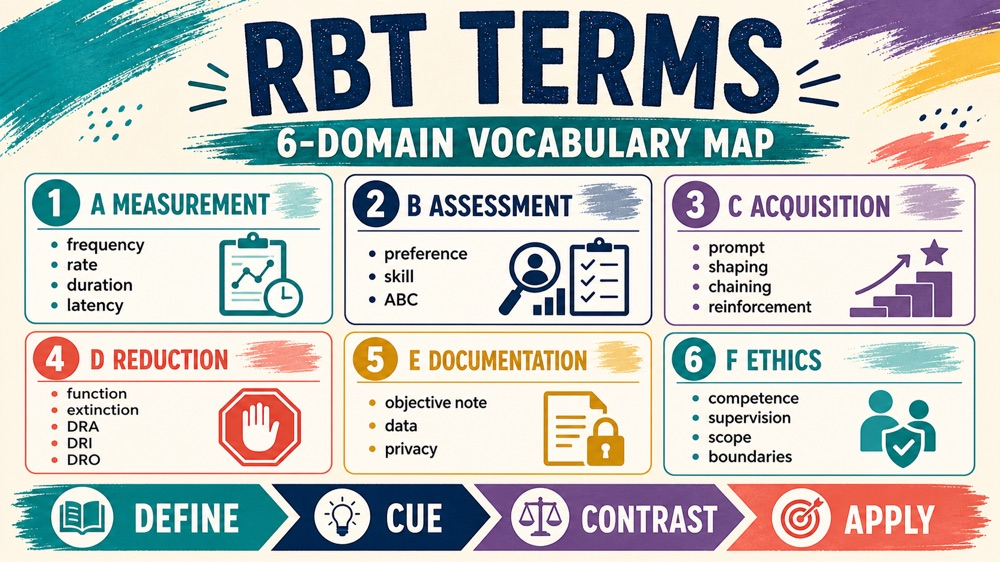
Map RBT terms to six domains
Use the current TCO as a map, not as a promise that a flashcard vendor’s topic percentage is official:
| Domain | Tasks | Term families to connect |
|---|---|---|
| A. Data Collection and Graphing | A.1–A.8 | frequency, rate, duration, latency, IRT, interval systems, permanent product, graph axes, trend, and level. |
| B. Behavior Assessment | B.1–B.3 | preference assessment, skill assessment, ABC information, observable description, and functional-assessment role boundaries. |
| C. Behavior Acquisition | C.1–C.11 | reinforcement, prompting, fading, shaping, chaining, discrimination, generalization, maintenance, DTT, and NET. |
| D. Behavior Reduction | D.1–D.7 | function, antecedent strategy, extinction, differential reinforcement, crisis or safety plan, and treatment fidelity. |
| E. Documentation and Reporting | E.1–E.4 | objective note, data communication, incident reporting, privacy, and escalation. |
| F. Ethics | F.1–F.10 | competence, supervision, scope, dignity, confidentiality, boundaries, self-reporting, and examination integrity. |
Each card should carry a domain tag and a “use in a stem” line. A term can appear in more than one domain. For instance, reinforcement belongs to acquisition, but an ethics or documentation item may ask whether the RBT implemented the written reinforcement plan accurately.
Domain A measurement terms
Measurement vocabulary becomes easier when you attach every term to a unit:
- Frequency/count: how many times a response occurs during an observation. Count alone is not comparable when observation lengths differ.
- Rate: count divided by a stated unit of time, such as responses per minute. Always look for the observation duration.
- Duration: how long a behavior lasts, defined by onset and offset.
- Latency: time from a stimulus, instruction, or cue to the beginning of the response.
- Interresponse time (IRT): time between consecutive responses of the same behavior.
- Permanent product: a lasting environmental result that can be measured after the behavior, when the product reliably represents the target behavior.
- Partial interval: record whether the behavior occurred at any point in the interval; it can overestimate occurrence or duration.
- Whole interval: record whether the behavior occurred throughout the entire interval; it can underestimate occurrence.
- Momentary time sampling: check whether the behavior is occurring at a specified moment, not at every point in the interval.
Do not choose a measurement because it sounds familiar. Ask “What is the unit?” and “What boundary did the stem give me?” That two-question routine prevents many duration/latency and count/rate errors.
Domain B assessment terms
Domain B terms describe how information is gathered and how an RBT supports an assessment under direction. A preference assessment identifies stimuli that may be preferred; it does not prove that an item will function as a reinforcer in every context. A skill assessment samples what a learner can do and where teaching may begin. ABC data records relevant antecedent, behavior, and consequence information in a defined situation; it is not automatically a functional analysis.
For each assessment term, separate:
- the purpose of the assessment;
- the exact presentation or recording procedure;
- what the data can and cannot establish; and
- what the RBT is authorized to implement versus what the supervisor interprets or changes.
Imagine a caregiver asks the RBT to announce the function of behavior after two ABC notes. The role-safe response is to record accurately and bring the question to the supervisor. A definition card that says “ABC finds function” is too broad and can lead to an unsafe scope decision.
Domain C acquisition terms
Acquisition terms describe how a skill is taught and supported:
- Reinforcement: a consequence that increases the future likelihood of a behavior; it is defined by its effect, not by whether the consequence looks pleasant.
- Prompt: an antecedent assistance that increases the chance of a correct response; prompt type and fading follow the written procedure.
- Shaping: reinforcing successive approximations toward a target response.
- Chaining: teaching a sequence of steps; forward, backward, and total-task procedures differ in where instruction begins and how the sequence is practiced.
- Discrimination: responding differently in the presence of different stimuli because the contingencies differ.
- Generalization: the skill occurs with new people, materials, settings, or examples; maintenance means the skill continues over time.
- DTT and NET: different teaching arrangements that must be identified from the antecedent, response opportunity, materials, and context described in the plan.
When a card says “reinforcement is a reward,” add the missing test: did the behavior increase? When a card says “prompting teaches the skill,” add the fading condition: can the learner respond independently after prompt support is reduced?
Domain D reduction terms
Behavior-reduction vocabulary must be learned with function, plan fidelity, and safety. Extinction means the consequence that previously maintained a behavior is no longer delivered according to the procedure; it is not “ignore everything.” Differential reinforcement reinforces a selected response pattern while the plan specifies what happens to the target behavior. DRA, DRI, and DRO are not interchangeable:
| Term | What the learner does | What the stem must show |
|---|---|---|
| DRA | Uses a specified alternative response. | The alternative is named and reinforced. |
| DRI | Uses a response incompatible with the target. | The two responses cannot occur together as defined. |
| DRO | Meets an interval or period without the target behavior. | The absence criterion and interval are specified. |
Never let a vocabulary shortcut override a written plan or safety procedure. An RBT implements assigned procedures, records observable results, and asks the supervisor when a plan is unclear or a risk appears.
Domain E documentation terms
Documentation terms are action words, not labels. An objective note describes observable events, relevant context, procedures used, data, and communication. A note that says “the client was lazy” does not tell the next reader what happened. A stronger note identifies the instruction, response, measurement, prompt, consequence, and follow-up.
For each documentation card, ask:
- Could another trained reader identify what was observed?
- Is the measurement unit or time period clear?
- Does the note distinguish fact from interpretation?
- Does it protect confidential information?
- Does it show who was notified and what remains unresolved?
Do not backfill or silently alter data to make a graph look better. If an entry is wrong, follow the organization’s correction process and preserve an honest record.
Domain F ethics terms
Domain F terms describe the RBT’s professional role. Scope of competence means the behavior-technician services and activities the RBT can accurately carry out. Close supervision means the RBT works under the direction of the BACB-required supervisor; it does not mean the RBT can independently answer every clinical question.
- Confidentiality and privacy: protect client information under BACB requirements, law, and employer policy; do not post identifying information.
- Multiple relationship: mixing professional and personal roles in a way that may create conflict or risk harm.
- Cultural responsiveness: work with the supervisor to evaluate bias, respect diversity, and obtain needed training.
- Self-reporting: know which events must be reported and follow the applicable BACB timeframe and process.
- Examination integrity: do not cheat, help others cheat, or collect, use, or distribute unauthorized examination materials.
A common mistake is treating “ask your supervisor” as the answer to every ethics item. Consultation is important, but immediate client protection, required reporting, accurate documentation, and following a safety plan may also be necessary. Read the full stem.
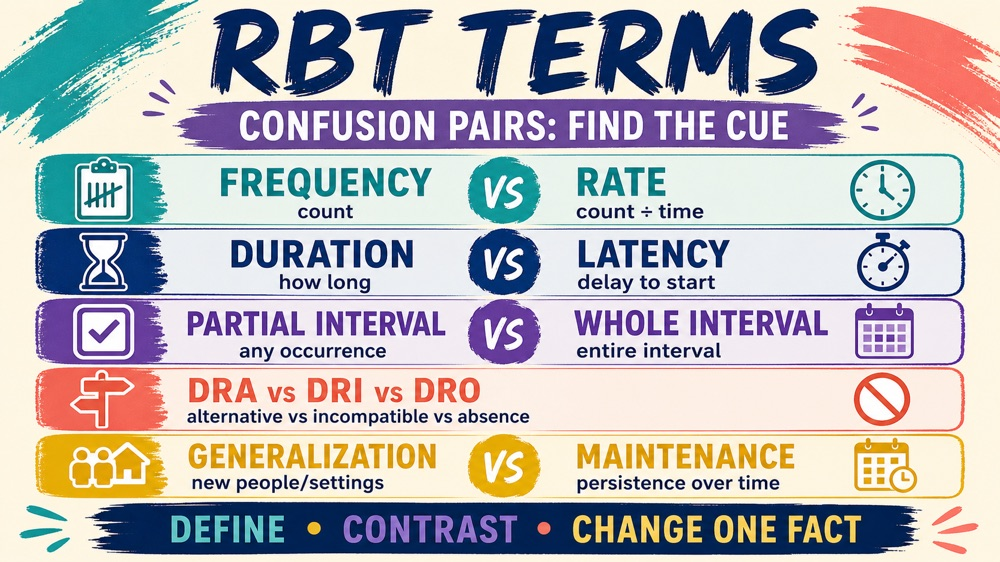
Use confusion pairs, not isolated definitions
The fastest way to improve RBT terms recall is to study the nearest wrong answer beside the correct one:
| Pair | Controlling distinction | Quick test |
|---|---|---|
| Frequency vs rate | Rate includes a time denominator. | Are observation lengths different? |
| Duration vs latency | Duration is how long the response lasts; latency is delay before it begins. | Where are onset and offset? |
| Partial vs whole interval | Any occurrence versus occurrence for the entire interval. | What must be true at interval end? |
| Preference vs reinforcer | Preference is selected or observed choice; a reinforcer is confirmed by an increase in behavior. | Did the behavior change? |
| Shaping vs chaining | Successive response approximations versus steps in a sequence. | Is the target one response form or a task sequence? |
| Generalization vs maintenance | New conditions versus persistence over time. | What changed: setting/person or time? |
| DRA vs DRI vs DRO | Alternative, incompatible, or absence of the target. | What response or absence criterion is named? |
| ABC data vs functional analysis | Naturalistic observation of events versus an arranged experimental test under qualified direction. | Were conditions systematically arranged? |
| Confidentiality vs anonymity | Confidential information is protected; anonymity means identity is not known or linked. | Could the person still be identified? |
Write one non-example for every pair. If your card only says what the correct term means, you may still choose it whenever you see a familiar word. A non-example forces you to look at the controlling fact.
Apply RBT terms to original scenarios
The following mini-stems are newly written for independent study. They are not official, recalled, leaked, or BACB-endorsed questions.
- Measurement: An RBT records the number of requests during a 20-minute observation and wants to compare it with a 40-minute observation. Best term: rate, because the time denominator makes the observations comparable. Nearest distractor: frequency alone.
- Latency: The plan records the seconds from the instruction “touch red” until the learner begins moving toward the card. Best term: latency. Nearest distractor: duration, which would require timing how long the response lasts.
- Assessment: A supervisor gives a written paired-choice preference procedure. Best action: follow the presentation and recording steps. Nearest distractor: announce that the selected item is definitely a reinforcer.
- Acquisition: A learner completes the last step of handwashing, receives reinforcement, and the plan then adds earlier steps. Best term: backward chaining. Nearest distractor: shaping, which concerns successive approximations to a response form.
- Reinforcement: A consequence is delivered after a response, but the response does not increase across opportunities. Best reasoning: do not call it a reinforcer solely because it was intended as a reward; check the effect and the plan.
- Reduction: The plan reinforces asking for a break instead of dropping to the floor. Best term: DRA if the alternative response is specified. Nearest distractor: DRO, which would use an absence criterion.
- Documentation: A note says “bad attitude.” Best correction: replace the label with observable actions, context, data, and procedures. Nearest distractor: add more adjectives.
- Ethics: A family asks for a recognizable video of a client to post online. Best concept: privacy and confidentiality; do not share identifying client information and consult the supervisor.
- Scope: A coworker asks the RBT to change the intervention because the current graph is flat. Best action: continue authorized implementation and bring the concern to the supervisor. Nearest distractor: change the intervention independently.
- Transfer: A learner performs a skill with one therapist but not with a new teacher. Best concept: generalization, not maintenance, because the person or context changed. The answer would shift toward maintenance if the same condition were tested over time.
Build a correction log and study plan
Turn each missed or low-confidence card into a small learning record:
| Field | Write |
|---|---|
| Term and domain | The term, current A–F domain, and closest TCO task pattern. |
| Definition | A one-sentence meaning with the unit, condition, or procedure. |
| Controlling cue | The fact in a stem that makes the term fit. |
| Nearest neighbor | The confusing term and why it does not fit this stem. |
| Non-example | A situation where the term would be wrong. |
| Changed fact | One change and the new answer. |
| Source and action | Official source, training material, supervisor question, or retest date. |
- Day 1: audit your set for current edition, source, domain, and definition quality.
- Day 2: review A measurement pairs and calculate at least three rate or interval examples.
- Day 3: review B and C; explain the purpose and role boundary of each assessment or teaching term.
- Day 4: review D and E; write one plan-fidelity and one objective-documentation scenario.
- Day 5: review F; connect competence, privacy, supervision, boundaries, and exam security to action.
- Day 6: run mixed retrieval without looking at the back, then correct with the nearest-neighbor method.
- Day 7: retest changed-fact versions and retire cards that are too vague to distinguish.
Bottom line: the best RBT terms study is not the longest list. It is a current, six-domain system that tells you what a term means, what evidence controls it, which neighbor is tempting, and how the answer changes when the stem changes.
Ready to apply your RBT terms?
Practice original scenarios, review the explanation behind each answer, and map the next term to study.
Try Free RBT Mock Exams →
Frequently Asked Questions
What are the most important RBT terms?
Start with terms from all six current TCO domains, especially measurement units, assessment purpose, reinforcement and prompting, behavior reduction distinctions, objective documentation, and ethics boundaries. Use the current BACB TCO as your map rather than a vendor’s card count.
How many RBT terms should I study?
There is no official flashcard count. A smaller set with definitions, controlling cues, contrasts, non-examples, and changed-fact practice is more useful than a large list that you only recognize.
What is the difference between duration and latency?
Duration measures how long a behavior lasts. Latency measures the delay from a specified stimulus or instruction to the beginning of the response.
Why do RBT terms need examples?
Exam-style stems test application. An example shows the controlling fact, while a non-example and nearest-neighbor contrast show when the term does not fit.
Are online RBT terms flashcards official BACB material?
Most third-party flashcards are independent study resources. Verify current exam facts with the BACB and do not treat online definitions or questions as official, recalled, leaked, or BACB-endorsed content.
Can RBT terms flashcards guarantee that I will pass?
No. Flashcards can support recall and discrimination, but no independent card set, article, course, or practice result can guarantee certification or a passing result.
References
- Behavior Analyst Certification Board. RBT Test Content Outline, 3rd edition.
- Behavior Analyst Certification Board. RBT Test Content Outline, 3rd-edition PDF.
- Behavior Analyst Certification Board. RBT Handbook.
- Behavior Analyst Certification Board. RBT certification resources.
- OpenExamPrep RBT flashcards. Reviewed for competitor research; not an endorsement.
- RBT Hub flashcards. Reviewed for competitor research; not an endorsement.
- The RBT Practice Test flashcards. Reviewed for competitor research; not an endorsement.