
SAFMEDS ABA flashcards can be useful for building quick, accurate responses to RBT concepts, but they are more specific than ordinary silent flashcards. The method uses a shuffled deck, an audible response, a brief timing, and daily data so you can see whether fluency is improving.
Table of Contents
- SAFMEDS ABA flashcards: what the method means
- SAFMEDS ABA flashcards versus ordinary flashcards
- How to build SAFMEDS ABA flashcards for the current RBT outline
- How to run one SAFMEDS ABA flashcards timing
- How to score and chart SAFMEDS data without overclaiming mastery
- Use error correction, nearest-distractor checks, and transfer
- Map SAFMEDS ABA flashcards to all six RBT domains
- Use a seven-day SAFMEDS ABA flashcards study plan
- Frequently Asked Questions
- References
For RBT preparation, that distinction matters. The current RBT examination is based on the RBT Test Content Outline, 3rd edition, which describes 43 tasks across six domains. The exam format is 85 multiple-choice questions, including 75 scored questions and 10 unscored questions, with four possible answers per question and 90 minutes. Flashcards can strengthen recall; they cannot replace training, competency assessment, supervision, scenario reasoning, or the current BACB Handbook.
This is independent educational content. RBT Training is not the BACB, is not a certification program, and is not affiliated with or endorsed by the BACB. All examples and prompts below are newly written and are not official, recalled, leaked, or BACB-endorsed questions. No flashcard deck, practice score, course, or study routine can guarantee certification or a passing result.
SAFMEDS ABA flashcards: what the method means
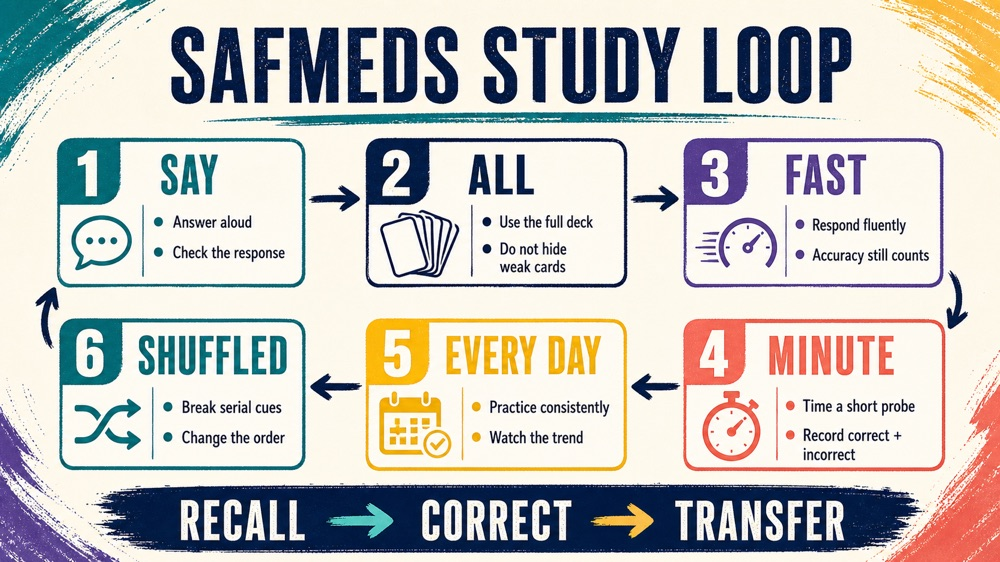
SAFMEDS is commonly expanded as Say All Fast a Minute Every Day Shuffled. The words are procedural cues, not decoration:
| Word | Study action | What to observe |
|---|---|---|
| Say | Produce an audible response rather than silently recognizing the answer. | Whether the response is accurate and understandable. |
| All | Work with the complete deck or the full planned set, not only the easiest cards. | Whether weak items remain hidden in a small practice pile. |
| Fast | Respond fluently during a short timing without turning the session into slow rereading. | Correct and incorrect responses per minute. |
| Minute | Use a brief, repeatable timing as the measurement sample. | Performance under a consistent time condition. |
| Every Day | Practice frequently enough to build a trend rather than cramming once. | Retention and stability across days. |
| Shuffled | Change the card order so serial position is not doing the work. | Whether the learner can respond to the concept in a new order. |
In the research literature, behavioral fluency combines speed and accuracy. A learner who can define “duration” after ten seconds of rereading may have recognition, but not necessarily a fast, stable response that transfers to a new scenario. A learner who answers rapidly but inaccurately also has not reached a useful criterion. SAFMEDS makes both dimensions visible.
The method is not a BACB application step, an official examination format, or a required part of the 40-hour training. It is a study procedure that can be used with independent, original cards. If a trainer or supervisor gives you a different timing, scoring, or mastery rule, follow the current instructional plan and ask what the rule is intended to measure.
SAFMEDS ABA flashcards versus ordinary flashcards
Many resources use “SAFMEDS” as a product label. The useful question is whether the deck and routine actually create an observable response and a usable data record.
| Ordinary flashcard review | SAFMEDS-oriented review | Why it matters for RBT study |
|---|---|---|
| Read the front, look at the back, and move on silently. | See a prompt, say the response, then verify it. | Shows whether you can retrieve the concept rather than recognize it. |
| Practice a small group until it feels familiar. | Use the full planned deck in shuffled order. | Reduces memory for the sequence and exposes neglected domains. |
| Count cards finished or study minutes. | Record correct and incorrect responses during a consistent timing. | Separates volume from performance quality. |
| Keep repeating the same answer until it is memorized. | Correct the error, change the context, and retest later. | Builds a route from recall to application. |
| Treat a high deck score as proof of exam readiness. | Use fluency as one signal, then test scenarios, ethics, pacing, and transfer. | Prevents a narrow score from becoming a guarantee. |
A deck can be digital or physical. The medium is not the defining feature. A digital deck that lets you tap the answer without saying it may be convenient, but it does not automatically implement a SAFMEDS response requirement. Likewise, a printed deck can still be weak if its definitions are outdated, its examples are vague, or its cards copy protected content.
How to build SAFMEDS ABA flashcards for the current RBT outline
Start with the current source map, not a random list of ABA vocabulary. The 3rd-edition TCO organizes 43 tasks across Domains A through F. Make a card inventory that names the domain and task cluster, then write an original prompt and a concise response for each concept.
- Choose one response channel: for example, “see definition, say term” or “see term, say operational definition.” Do not switch directions without recording which direction you practiced.
- Write a discriminating front: include the feature that separates the concept from its nearest neighbor, not a paragraph that gives away the answer.
- Write a checkable back: include a plain-language definition, one boundary, and one small example. Keep the example newly written.
- Tag the domain: label A, B, C, D, E, or F so a weak trend can lead to targeted review.
- Add a transfer prompt: after recall improves, ask what the RBT should do in a new setting or when the plan is unclear.
- Version the source: record the source title and date on your study log. Do not call a private deck official or imply that it contains real exam items.
A useful card is short enough to answer quickly but precise enough to prevent a false match. For example, the front might say: “A measurement that records the total time a behavior occurs: say the term.” The back can say “duration,” followed by a note such as “not frequency, which counts events.” A second card can reverse the channel: “See duration; say what it records.” Bidirectional practice helps reveal whether you know the relation or only one memorized sentence.
Do not copy a commercial deck, a Quizlet set, a training provider’s proprietary examples, or secure examination questions. Create original cards from public, current sources and your own learning notes. If a card contains a claim that affects a client’s treatment, stop and verify it with the written plan and supervisor rather than turning a flashcard into an independent clinical instruction.
How to run one SAFMEDS ABA flashcards timing
Use the following as a study example, not as a universal BACB criterion. Prepare the complete planned deck, shuffle it, choose the response direction, and set a one-minute timer. Respond aloud as quickly as you can while preserving accuracy. If you do not know a card, say “pass” or use the correction rule you selected; do not spend the entire timing staring at one item.
- Prepare: remove duplicates, check that every card has a source note, and place the full set within reach.
- Shuffle: change the order enough that the previous sequence cannot cue the answer.
- State the channel: say “see term, say definition” or “see definition, say term.”
- Time: start the one-minute timing and respond to as many cards as possible.
- Verify: turn or check each card after responding and mark correct, incorrect, or passed.
- Count: record correct and incorrect responses from the timing; keep the scoring rule consistent.
- Correct: review errors immediately, but do not erase them from the record.
- Repeat: practice again later or the next day with a shuffled order and a changed context.
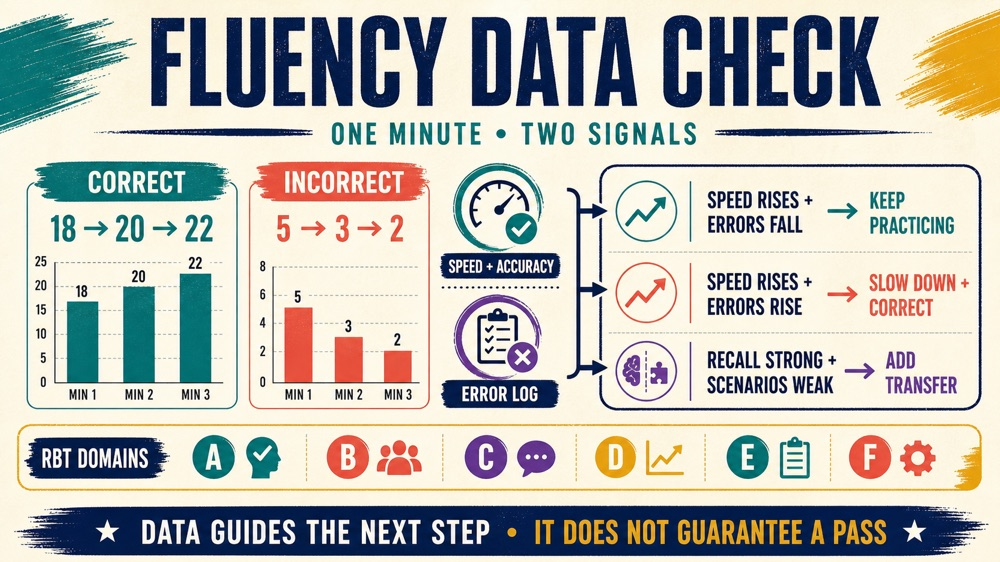
The objective is not to race into careless guessing. “Fast” means fluent responding under the chosen timing while the answer remains correct. If speed rises while errors rise sharply, reduce the response difficulty, improve the card wording, or spend more time on error correction before increasing the pace.
How to score and chart SAFMEDS data without overclaiming mastery
Keep a small log with the date, deck version, response direction, correct count, incorrect count, and a short note about the main error type. A simple table is enough:
| Date | Direction | Correct | Incorrect or passed | Next decision |
|---|---|---|---|---|
| Monday | Definition → term | 18 | 5 | Correct measurement distractors before adding new cards. |
| Tuesday | Definition → term | 20 | 3 | Retest the three errors in changed settings. |
| Wednesday | Term → definition | 15 | 6 | Practice the reverse channel and tighten definitions. |
This record answers better questions than “How many cards did I finish?” Did accuracy improve? Did the reverse direction remain strong? Did errors cluster in one domain? Did performance hold after a day without practice? Did you apply the concept in a scenario?
Some precision-teaching materials use a Standard Celeration Chart or a formal fluency aim. Those tools can be useful when you know how to use them, but a chart is not required to make a private study log meaningful. Do not borrow a numeric mastery criterion from a paper, course manual, or product page and present it as an official RBT passing threshold. The BACB does not certify a particular flashcard routine.
Also separate card-level mastery from exam readiness. You may respond quickly to “What is extinction?” and still miss a scenario that asks what to do when an extinction procedure is written but a safety concern appears. Recall is a foundation; application and supervision judgment are additional checks.
Use error correction, nearest-distractor checks, and transfer
When a response is incorrect, do not simply flip the card and continue. Use a short correction sequence:
- Say the correct response aloud.
- State the feature that makes it correct.
- Name the nearest wrong answer and why it does not fit.
- Repeat the original card once without looking at the back.
- Create or select a new example that changes the setting but preserves the rule.
Example: the card asks for the measure that records the time between an instruction and the beginning of a response. If you answer duration, the correction is not only “latency.” State that latency is elapsed time from the stated event to response onset, then contrast it with duration, which measures how long the response lasts. Finally, solve a new classroom or home example without reusing the original wording.
For ethics and documentation cards, make the transfer step role-sensitive. If a prompt asks what to do when data look unusual, the answer may be to document the observation and contact the supervisor according to the plan, not to alter the measurement system independently. If a prompt involves privacy, ask whether the proposed action confirms a client relationship or shares information with an unauthorized person.
When an error persists, inspect the card itself. The definition may be too broad, two terms may be used inconsistently, or the example may accidentally contain multiple answers. A good deck audits its own prompts.
Map SAFMEDS ABA flashcards to all six RBT domains
Use the current TCO to prevent a deck from becoming a collection of only popular terms. The exact question distribution is a study-planning signal, not a separate domain passing rule:
| Domain | TCO emphasis | Card prompt example |
|---|---|---|
| A. Data Collection and Graphing | 13 questions (17%) | See a definition; say the measure and what it records. |
| B. Behavior Assessment | 8 questions (11%) | See a short observation; say what to record and what not to infer. |
| C. Behavior Acquisition | 19 questions (25%) | See a teaching step; say the prompt, consequence, or generalization feature. |
| D. Behavior Reduction | 14 questions (19%) | See a plan feature; say the role-appropriate implementation or escalation. |
| E. Documentation and Reporting | 10 questions (13%) | See a session event; say what objective information belongs in the note. |
| F. Ethics | 11 questions (15%) | See a boundary problem; say how to protect privacy, dignity, and supervision. |
These percentages come from the current 3rd-edition TCO. They do not mean that you can skip a lower-count domain. A small error cluster in ethics or documentation can still reveal a serious role-boundary problem, while a large acquisition deck can create false confidence if every card tests only a definition.
Use a seven-day SAFMEDS ABA flashcards study plan
- Day 1: read the current Handbook and TCO; inventory the deck by six domain and source date.
- Day 2: practice Domain A and B cards in one direction, record correct and incorrect responses, and repair ambiguous definitions.
- Day 3: practice Domain C cards; add one transfer example for prompting, reinforcement, teaching, and generalization.
- Day 4: practice Domain D cards; separate plan fidelity, behavior function, safety, and independent treatment changes.
- Day 5: practice Domain E and F cards; write objective documentation and privacy-boundary rationales.
- Day 6: run both response directions, then complete original scenario items with no answer choices.
- Day 7: complete a timed mixed practice set, review every miss or guess, and choose the next weak domain.
Use the deck to make the next decision. If your errors are mostly vocabulary retrieval, keep the timing short and consistent. If retrieval is fast but scenarios are weak, stop adding cards and practice transfer. If the issue is a current requirement, do not solve it with more flashcards; return to the current BACB source or ask the appropriate supervisor or trainer.
Bottom line: SAFMEDS ABA flashcards are most useful when they create an audible response, a short timing, a shuffled order, and a trend of correct and incorrect performance. Use them to build fluency with original RBT concepts, then add application, ethics, documentation, pacing, and supervision decisions. A fast answer on a flashcard is evidence for one skill—not proof of certification readiness.
Build a better RBT study routine
Use current-source review, original practice, and clear explanations to find your next weak concept.
Try Free RBT Practice Questions →
Frequently Asked Questions
What are SAFMEDS ABA flashcards?
They are flashcards used with a fluency-oriented routine: say the response aloud, work through the planned deck, respond quickly while accurate, use a brief timing, practice regularly, and shuffle the cards. The routine is a study method, not an official BACB requirement.
Are SAFMEDS the same as regular flashcards?
Not necessarily. Regular flashcards may involve silent recognition and untimed review. SAFMEDS emphasizes an observable response, speed and accuracy, a shuffled deck, and performance data. A product called SAFMEDS should still be checked for how it actually instructs the learner to practice.
Do SAFMEDS guarantee that I will pass the RBT exam?
No. They can strengthen recall and fluency, but they do not replace current training, competency assessment, scenario application, supervision, or exam-day judgment. No deck or practice score can guarantee certification or a passing result.
How long should I practice SAFMEDS each day?
Published educational procedures use brief daily practice and timed probes, but there is no single BACB-required duration for an RBT candidate. Choose a consistent routine, protect accuracy, record your data, and follow your trainer or supervisor when a formal course sets a different procedure.
What should go on an RBT flashcard?
Use one precise concept, an original prompt, a concise answer, one distinguishing feature, a domain tag, and a source note. Add a new-context scenario after recall improves. Do not copy protected exam questions or call private study content official.
Should I use flashcards for every RBT domain?
Yes, use the current TCO to map cards across Domains A through F. Do not let card quantity replace coverage: data, assessment, acquisition, reduction, documentation, and ethics each need recall and application practice.
References
- Behavior Analyst Certification Board. RBT Handbook.
- Behavior Analyst Certification Board. Examination Information.
- Behavior Analyst Certification Board. RBT Test Content Outline (3rd ed.).
- Behavior Analyst Certification Board. RBT 3rd-Edition Test Content Outline PDF.
- Stockwell, F., & Eshleman, J. A Case Study Using SAFMEDS to Promote Fluency with Skinner’s Verbal Behavior Terms. Journal of Precision Teaching and Celeration.
- Ball State University. ABA with an Emphasis in Autism Capstone Manual. Reviewed for educational procedure examples.
- ABA Resource Center RBT Flashcards/SAFMEDS. Reviewed for competitor research; not an endorsement.
- The RBT Practice Test flashcards page. Reviewed for competitor research; not an endorsement.
- ABA Flash RBT Exam Study Cards. Reviewed for competitor research; not an endorsement.